


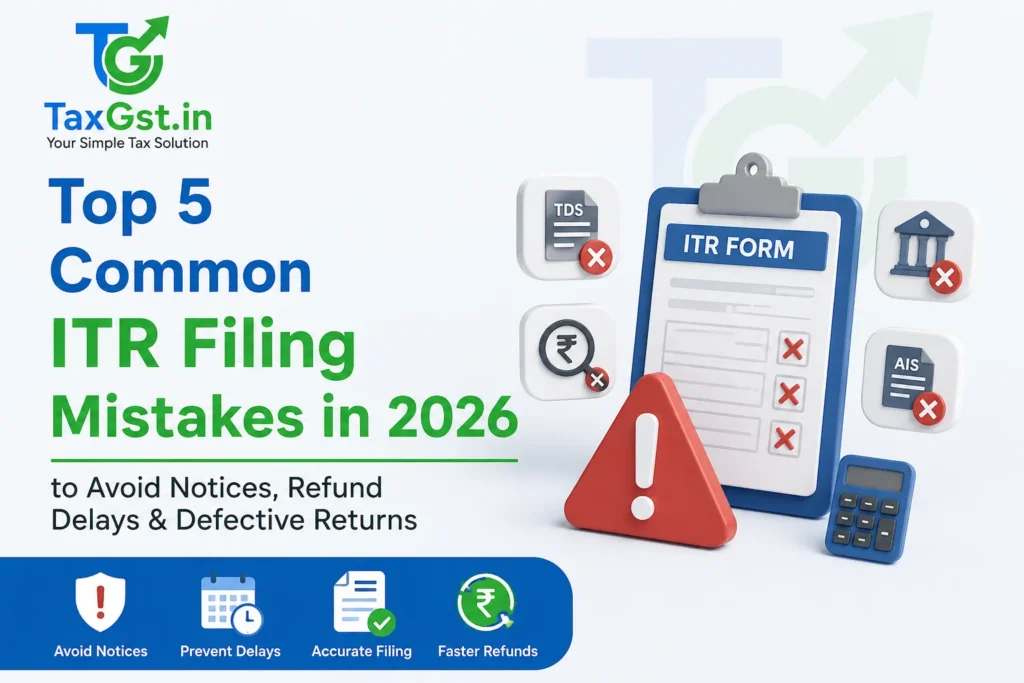
Are you rushing to file your ITR for AY 2026-27 without verifying critical details? Even small errors can trigger defective returns, refund delays, or notices from the Income Tax Department. With the new Income Tax Act, 2025 now in force (though AY 2026-27 still operates under the old Act), updated capital gains rates, and stricter AIS-based scrutiny, taxpayers must be extra cautious. Here are the top mistakes to avoid this filing season.
1. Selecting the Wrong ITR Form
Choosing an incorrect ITR form is one of the most frequent causes of defective returns under Section 139(9). Each form has specific eligibility criteria:
| ITR Form | Generally Applicable For |
|---|---|
| ITR-1 | Salary income, one house property, other sources (interest), and long-term capital gains up to ₹1.25 lakh under Section 112A. |
| ITR-2 | Multiple house properties, standard short-term or long-term capital gains, foreign assets/income. |
| ITR-3 | Business or professional income, stock trading profits, or partnership returns. |
| ITR-4 | Presumptive business income under Sections 44AD, 44ADA, or 44AE. |
Filing ITR-1 when you have business income or multiple capital gains transactions will result in rejection. Always cross-check your income profile before selecting the form.
2. Income Mismatch with AIS and Form 26AS
The Annual Information Statement (AIS) and Form 26AS are now comprehensive data repositories used by the department to auto-validate returns. Mismatches—even minor ones—trigger automated notices u/s 143(1).
Commonly reported transactions include:
- Bank interest (reported automatically by financial entities)
- TDS entries (reported directly by corporate deductors)
- Salary income components matching your Form 16
- High-value cash deposits, property registrations, and mutual fund purchases (reported under SFT tracking logs)
Before filing, log in to incometax.gov.in → AIS tab, review every entry, and submit feedback for discrepancies. Ignoring this step may lead to disallowed TDS claims or unexplained income queries.
3. Not Reporting All Income Sources
Many taxpayers overlook reporting certain incomes, assuming they’re exempt or negligible. However, all income must be disclosed, even if exempt.
Commonly missed items:
- Savings account interest (mandatory under ‘Income from Other Sources’)
- Rental income from house property
- Capital gains from equity, debt funds, or real estate
- Dividend income (even if tax-free in hands of recipient)
For example, if you earned ₹18,000 as interest from savings accounts across two banks, it must be reported—even though it’s below the ₹10,000 threshold for deduction under Section 80TTA (old regime).
4. Wrong or Fake Deduction Claims
Overclaiming deductions—especially under Section 80C—is a red flag. The e-filing portal now enforces strict validation rules. For instance, total deductions under Sections 80C, 80CCC, and 80CCD(1) cannot exceed ₹1.5 lakh in the old regime, as per ITR-1 validation rules for AY 2026-27.
Fake rent receipts, inflated HRA claims without actual rent payment, or unsupported medical bills under Section 80DDB can attract penalties:
- Under-reporting (procedural error): Penalty up to 50% of tax on undisclosed income.
- Misreporting (with fabricated documentation): Penalty up to 200%.
5. Filing Near Deadline Without E-Verification
A return filed but not e-verified within 30 days is treated as never filed, as per rule 12 of the Income-tax Rules, 1962. This remains unchanged for AY 2026-27.
Last-minute filers often skip e-verification due to portal glitches or time pressure, leading to compliance failure. Use Aadhaar OTP, net banking, or EVC via mobile/email immediately after uploading.
- Verify AIS/TIS before filing—don’t rely solely on Form 16
- Use correct ITR form based on income type
- Report all income, including exempt items
- Claim only genuine deductions within prescribed limits
- E-verify within 30 days to avoid return invalidation
6. Ignoring the 30-Day E-Verification Deadline
Many taxpayers assume that uploading the ITR is the final step—but it’s not. As per rule 12 of the Income-tax Rules, 1962, an electronically transmitted return must be verified within 30 days of filing, or it will be treated as invalid. This rule remains strictly enforced for AY 2026-27, with no grace period.
E-verification can be done via Aadhaar OTP, net banking, EVC through mobile/email, or by mailing a signed ITR-V to CPC Bengaluru. If you miss the window, your return is deemed never filed, triggering late filing fees under Section 234F and potential scrutiny. For instance, if you file on 30 July 2026 but forget to e-verify until 5 September 2026, your return is considered filed only on 5 September—making it late and subject to penalties.
7. Filing Too Early Without Reconciling AIS/TIS Data
While early filing seems proactive, doing so before AIS and TIS are fully updated is risky. Banks, employers, deductors, and financial institutions report data gradually—TDS for Q4 may not reflect until late April, and SFT entries (like high-value deposits or mutual fund purchases) often upload by May.
Filing before reconciliation increases the chance of mismatches. The department’s system auto-flags discrepancies between your ITR and AIS, leading to Section 139(9) defective return notices or Section 143(1) adjustment notices. For example, if your bank reports ₹25,000 in interest income in AIS but you report only ₹18,000, the difference triggers an automated query—even if it was an honest oversight.
Best practice: Wait until mid-June 2026 to file, unless you’re certain all data is uploaded and reconciled.
8. Misunderstanding Capital Gains Reporting Post-Budget 2024
Budget 2024 overhauled equity capital gains taxation effective 23 July 2024. For AY 2026-27, only STCG at 20% and LTCG at 12.5% (above ₹1.25 lakh) apply—the old 15% STCG and 10% LTCG rates no longer exist. Importantly, ITR-2 and ITR-3 forms for AY 2026-27 have removed date-split reporting fields (pre/post 23 July 2024).
Taxpayers who continue using old worksheets or software not updated for these changes risk underreporting tax liability. For example, selling equity shares held for 14 months in February 2026 requires LTCG tax at 12.5% on gains exceeding ₹1.25 lakh—not 10%. Failing to apply the correct rate may lead to demand notices under Section 143(1).
9. Misreporting Cryptocurrencies and Virtual Digital Assets (VDAs)
A catastrophic mistake for retail investors is trying to offset losses from crypto or NFTs against regular stock market gains, or failing to report small token transactions. Under Section 115BBH, all income derived from Virtual Digital Assets is subject to a strict flat 30% tax rate (+ applicable surcharge and cess).
- No Expense Deductions: No deduction is allowed for any expenditure or allowance except the direct cost of acquisition. Infamous gas fees, mining setup costs, and transfer platform charges cannot be deducted.
- Zero Loss-Offsetting: Losses incurred from selling one specific token (e.g., Bitcoin) cannot be used to reduce taxable gains earned on another token (e.g., Ethereum).
- No Salary/Business Offsets: Crypto losses cannot be carried forward to future years or offset against standard heads of income like salary or property earnings.
10. Accepting Erroneous AIS Entries Without Formal Feedback Loops
Many taxpayers assume the pre-filled numbers drawn from the AIS dashboard are infallible. However, data duplication by reporting entities (like a bank double-reporting a single fixed deposit interest payout under two slightly different branch codes) is a recurring issue. Simply ignoring a faulty AIS item and typing your true lower figures into the ITR will trigger an **automated mismatch notice** during initial processing.
To protect your return, you must execute the portal’s native **AIS Feedback Loop** before submission. Log into your profile, click on the erroneous information field under the AIS tab, and submit active digital feedback (such as *’Information is duplicate / included in other category’* or *’Information is denied’*). Once submitted, the portal dynamically adjusts your pre-filled database matrix, allowing your customized return to pass verification filters smoothly.
11. Overlooking Revised Return Deadlines and Fees
If you discover an error after filing, you can submit a revised return under Section 139(5). For AY 2026-27, this must be done by 31 March 2027. However, revised returns filed after 31 December 2026 incur a fee:
| Total Income | Filing Date | Revision Fee |
|---|---|---|
| Up to ₹5 lakh | After 31 December 2026 | ₹1,000 |
| Above ₹5 lakh | After 31 December 2026 | ₹5,000 |
Note: The original return must be verified before a revised one can be filed. Also, revised returns cannot change the tax regime selected—once opted, the regime is locked for that assessment year.
12. Confusing AY 2026-27 with the New Income Tax Act, 2025
A critical transitional confusion: AY 2026-27 (for FY 2025–26) is governed by the Income-tax Act, 1961, even though the new Income Tax Act, 2025 came into force on 1 April 2026. The new Act applies only from Tax Year 2026–27 onwards (returns due in 2027).
Using new Act provisions—like updated deduction limits or revised slab structures—while filing for AY 2026-27 will result in errors. Stick to the old Act’s rules, including Section 87A rebate limits (₹12,500 for old regime, ₹60,000 for new regime up to ₹12 lakh income) and existing TDS sections.
Sources
- TaxGuru — Top 5 Common ITR Filing Mistakes in 2026
- TaxGuru — Key ITR Filing Mistakes for AY 2026-27
- Income Tax Portal — Notification No. 45/2026
- Income Tax Portal — ITR-1 Validation Rules for AY 2026-27
- Income Tax India — Notification No. 51/2026
Next Steps Checklist
To ensure a smooth, error-free ITR filing experience for AY 2026-27, follow this practical checklist:
- Review AIS and TIS thoroughly – Log in to incometax.gov.in and verify all income, TDS, and high-value transactions under the AIS tab. Submit feedback for any discrepancies before filing.
- Reconcile Form 16 with Form 26AS – Ensure salary, TDS, and advance tax details match across documents. Missing or mismatched entries can delay refunds.
- Confirm correct ITR form eligibility – Use ITR-1 only if you have salary, one house property, and limited capital gains. Business income requires ITR-3 or ITR-4.
- Report every source of income – Include savings interest, dividends, rental income, and exempt income like agricultural earnings (up to ₹5,000).
- Validate deduction claims – In the old regime, total Section 80C + 80CCC + 80CCD(1) claims cannot exceed ₹1.5 lakh. Unsupported claims may be disallowed.
- E-verify within 30 days – Use your banking profile, secure EVC codes, or linked mobile verification immediately after uploading. Unverified returns are treated as never filed.
- File revised returns promptly if needed – Errors can be corrected until 31 March 2027, but revisions after 31 December 2026 incur fees (₹1,000 if income ≤ ₹5 lakh; ₹5,000 otherwise).
Frequently Asked Questions
Can I file ITR-1 if I have capital gains from equity mutual funds?
Yes, but only if your total income is up to ₹50 lakh, you are an ordinarily resident individual, and your long-term capital gains under Section 112A do not exceed ₹1.25 lakh. If gains exceed this or you have short-term capital gains, you must file ITR-2.
What happens if I miss the 30-day e-verification window?
Your return will be treated as invalid under rule 12 of the Income-tax Rules, 1962. You’ll need to re-file and e-verify, and late filing fees under Section 234F may apply if the new submission is after the due date.
Is it safe to file ITR in April 2026?
Not advisable. TDS for Q4 (Jan–Mar 2026) may not reflect in Form 26AS until late April, and AIS data from banks, brokers, and GST systems is often incomplete until May. Filing too early increases mismatch risks and notice triggers.
Do I need to report savings account interest below ₹10,000?
Yes. All interest income must be disclosed under ‘Income from Other Sources,’ even if below the ₹10,000 threshold for Section 80TTA deduction (old regime). Non-reporting creates AIS mismatches.
Can I claim HRA without paying actual rent?
No. HRA exemption under Section 10(13A) requires actual rent payment to a landlord (with PAN if rent exceeds ₹1 lakh annually). Fake rent receipts attract penalties up to 200% for misreporting.
What is the deadline for revised returns in AY 2026-27?
You can file a revised return under Section 139(5) anytime before 31 March 2027. However, revisions filed after 31 December 2026 incur a fee of ₹1,000 (if total income ≤ ₹5 lakh) or ₹5,000 (if above ₹5 lakh).
Does the new Income Tax Act, 2025 apply to AY 2026-27?
No. Returns for AY 2026-27 (income earned in FY 2025-26) are governed by the Income-tax Act, 1961. The new Act applies only from Tax Year 2026-27 onwards (returns due in 2027).
How do I correct a defective return notice under Section 139(9)?
Respond within 15 days by uploading a correction through the e-filing portal. If the defect relates to form selection or income mismatch, you may need to file a revised return with proper reconciliation.
Practical Notes Before You Act
If you are using this guide to make a filing, claim, application, withdrawal or compliance decision, treat the official portal as the final source of truth. Portal labels, document upload rules, OTP flow and processing timelines can change without much public notice, especially around deadline periods. Before submitting anything, keep a screenshot or PDF copy of the acknowledgement, payment receipt and any reference number generated on the portal.
For Income Tax matters, the safest approach is to verify three things before you proceed: whether the rule is currently active, whether your specific facts fit the eligibility conditions, and whether any employer, bank, department or portal approval is required after your submission. This avoids the common situation where the online form is filed correctly but the application remains pending because one supporting step was missed.
Documents and Details to Keep Ready
- Identity and account details – Keep PAN, mobile number linked to PAN, bank account details for refund routing, and your e-filing portal login credentials ready where applicable.
- Proof documents – Keep Form 16, Form 26AS / AIS ledger panels, investment proofs for deductions, salary slips, and portal e-Pay tax integrated e-receipts in a clear format before starting the process.
- Reference numbers – Note down PAN string, acknowledgment number, transaction IDs, e-Verification code, and ITR reference ID exactly as displayed.
- Date records – Save the submission date, approval date and any deadline mentioned in the portal message, because these dates matter if you need to follow up later.
Common Reasons for Delay or Rejection
Most delays happen because the application data does not match the records already available with the department, employer, bank or portal. A small mismatch in name, date of birth, bank account, mobile number or document number can push the request into manual verification. If your application is rejected, do not immediately file a fresh request with the same details. First identify the exact rejection reason, correct the master data if required, and then resubmit.
Another practical issue is duplicate or incomplete submissions. If the portal shows a pending request, wait for the status to update or use the official grievance/helpdesk route instead of repeatedly submitting new applications. Multiple pending entries for the same request profile configuration can slow down processing rather than speed it up.
Article Information
Published: May 28, 2026
Last Reviewed: May 28, 2026
Category: Income Tax
Regulatory Body: CBDT (Central Board of Direct Taxes)
Written by C.K. Gupta, M.Com & Tax Editor at TaxGST.in — helping 500+ clients navigate IT notices, GST audits, and ITR filings across Delhi NCR since 2009.
Official Resources
Disclaimer: This article is for informational purposes only. For legal advice, consult a qualified tax professional. Always refer to the original source document for authoritative information.
Discover more from TaxGst.in
Subscribe to get the latest posts sent to your email.





Stay Updated!
Join our community for latest tax updates, GST news & finance tips