


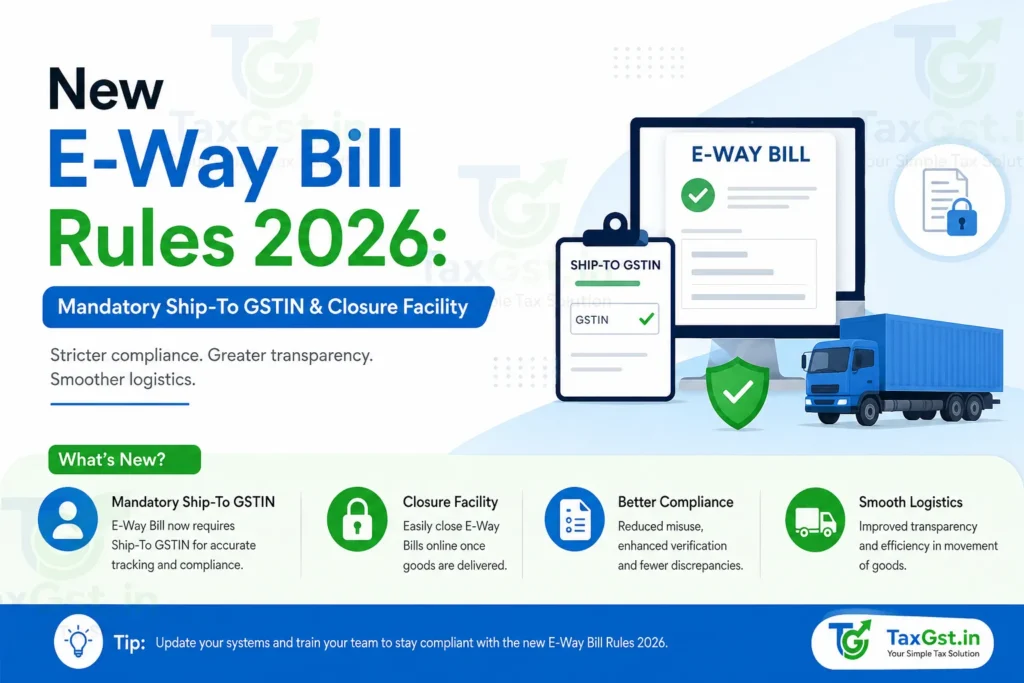
If you move goods valued over ₹50,000 under GST, two critical changes effective from mid-2026 will directly impact your compliance workflow—starting with mandatory capture of Ship-To GSTIN in Bill-To/Ship-To transactions and the new voluntary e-Way Bill closure facility. Ignoring these updates risks validation errors on the portal, delivery delays, and potential penalties under Section 129 of the CGST Act, 2017.
Quick Summary
- Ship-To GSTIN is now mandatory for Bill-To/Ship-To transactions; use “URP” for unregistered consignees.
- E-Way Bills can be voluntarily closed post-delivery by suppliers, recipients, transporters, or authorized field drivers.
- Closure is allowed on the same day or the immediately succeeding day via portal login or secure OTP mobile authentication.
- API changes are fully live in Sandbox; production rollout takes effect by 15 June 2026.
Mandatory Ship-To GSTIN: What Changed and Why It Matters
As per the latest GSTN advisory dated 20 May 2026, the e-Way Bill portal now mandates capturing the Ship-To GSTIN during generation when the billing and delivery locations differ. This applies strictly to Bill-To/Ship-To scenarios—for example, when a manufacturer in Maharashtra invoices a distributor in Gujarat but ships directly to a retailer in Karnataka. If the consignee is registered, their actual GSTIN must be entered.
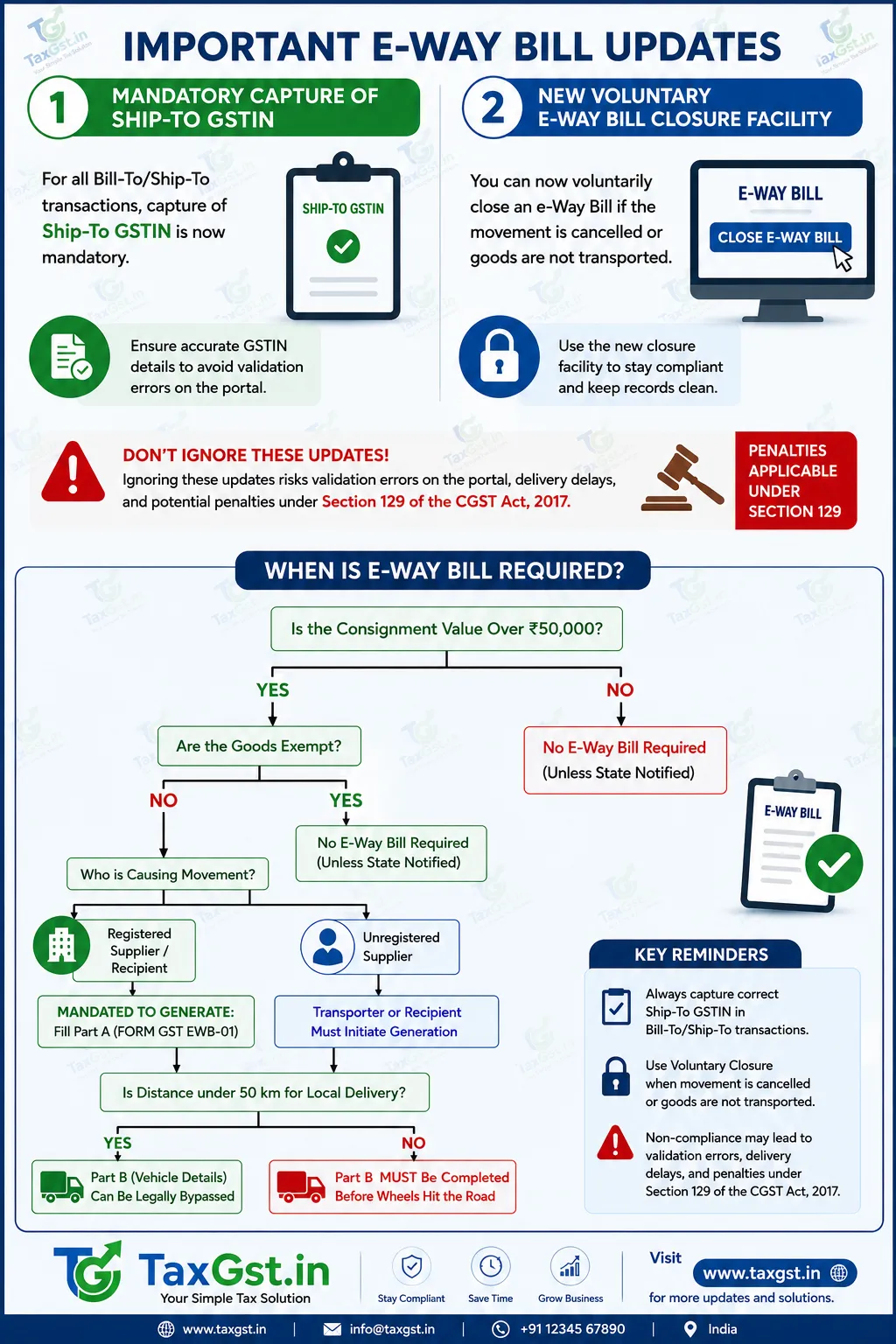

If the consignee is unregistered, taxpayers must input “URP” (Unregistered Person) in the Ship-To GSTIN field. This enhancement strengthens transaction-level traceability and aligns with the government’s push toward granular data integrity under Rule 138 of the CGST Rules, 2017. Failure to comply may result in immediate e-Way Bill rejection or scrutiny during physical transit verification.
Introducing the E-Way Bill Closure Facility
A long-awaited operational relief comes in the form of a voluntary e-Way Bill closure mechanism. Previously, inactive or completed e-Way Bills remained open indefinitely until expiry, creating clutter and compliance data risks. Now, once goods are safely delivered (or if movement is canceled prior to transit), any of the following stakeholders can systematically close the record:
- Supplier
- Recipient
- Transporter
- Driver or authorized person (via registered mobile number + OTP verification)
Closure is permitted either on the day of delivery or the immediately succeeding day. Users can close bills individually (e-Way Bill-wise) or in bulk (date-wise). For drivers and field personnel, mobile-based closure via OTP simplifies transit compliance without requiring master portal passwords. Notably, a mobile number can be linked at multiple stages—during generation, vehicle updation, or validity extension—ensuring robust operational flexibility.
Defending ITC: Legal Benefits of the Closure Entry
Beyond logistics optimization, utilizing the voluntary closure facility provides massive litigation insurance for commercial taxpayers. Under Section 16(2)(b) of the CGST Act, 2017, a registered recipient can only claim Input Tax Credit (ITC) if they have genuinely received the underlying goods. During GST audits, departments regularly challenge ITC on the grounds of suspected “fake invoices” or circular trading if transit logs look incomplete.
By ensuring that the recipient or driver marks the e-Way Bill as “Closed – Delivered” on the portal within the permissible 48-hour window, the company establishes an officially timestamped, government-hosted digital acknowledgment of receipt. This record works alongside the lorry receipt (LR) to build an airtight defense during adjudication audits.
Validity Rules and Practical Example
The validity of an e-Way Bill remains strictly governed by transit distance and cargo type, as structured under Notification No. 09/2023-CT. Below is the updated tracking framework:
| Cargo Type | Distance | Validity Period |
|---|---|---|
| Regular Cargo | Up to 200 km | 1 Day |
| Regular Cargo | Every additional 200 km or part thereof | +1 Day |
| Over Dimensional Cargo (ODC) | Up to 20 km | 1 Day |
| ODC | Every additional 20 km or part thereof | +1 Day |
For instance, a consignment moving 350 km by regular truck generated at 11:00 PM on 15 April 2026 will expire at 11:59 PM on 17 April 2026 (2-day validity). Validity extensions are allowed up to 4 hours before or after expiry, but beyond that, a fresh e-Way Bill is required. Businesses must act now: update ERP configurations, train dispatch staff, and test API integrations ahead of the 15 June 2026 production deployment. Non-compliance exposes stakeholders to vehicle detention under Section 129 and statutory penalties under Section 122 of the CGST Act.
Process for Generating and Updating E-Way Bills Under the New Framework
The generation of an e-Way Bill begins with furnishing Part A of FORM GST EWB-01 on the common portal, which includes consignor and consignee GSTINs, delivery details, invoice elements, HSN codes, and reason for movement. As per Rule 138 of the CGST Rules, 2017, this step is mandatory for all registered persons causing movement of goods exceeding ₹50,000 in total consignment value. Once Part A is submitted, a unique e-Way Bill Number (EBN) is instantly allocated.
Part B, containing vehicle numbers or transporter details, must then be filled in before the physical movement of the truck begins. Notably, if goods are handed over directly to a logistics company without a completed bill, the supplier must still furnish the specific transporter details in Part A, after which the transporter holds the clearance right to generate the final e-Way Bill using that baseline EBN. This dual-responsibility architecture maintains structural accountability across commercial supply chains.
Handling Multi-Vehicle Transshipment Shifts Correctly
A common point of operational confusion is managing transshipment—the process where a cargo consignment is transferred from one conveyance to another mid-journey (such as transferring goods from a long-haul inter-state container truck to multiple small inner-city distribution vans). Under Rule 138(2), before any such transfer takes place, the transporter is legally required to update the fresh vehicle details in Part B of the e-Way Bill on the portal.
If the movement involves shifting the cargo into multiple vehicles simultaneously, the user must utilize the “Consolidated e-Way Bill” architecture or generate distinct sub-consignments using individual tracking references. Moving a single intact consignment number across split road units without formal vehicle updates triggers automatic validation alerts on flying-squad verification modules.
Documents to Be Carried During Transit and Verification Protocols
As per Rule 138A, the person-in-charge of the conveyance must carry a valid tax invoice or bill of supply, alongside a digital or physical copy of the generated e-Way Bill. For import movements, a clear copy of the associated Bill of Entry is strictly required. During transit, officers authorized under Section 68 of the CGST Act, 2017 may intercept vehicles for checkpoint verification. However, Circular No. 36/10/2018-GST mandates that physical inspection should occur only once per journey unless specific data-driven intelligence suggests structural evasion.
Upon checkpoint interception, an initial summary report in Part A of FORM GST INS-03 must be uploaded to the portal within 24 hours, followed by the final verification report in Part B within three days. If vehicle detention under inspection holds exceeds 30 minutes, transporters are legally entitled to file FORM GST INS-04 via ICEGATE/GSTN to record the delay, protecting commercial logistics against arbitrary field harassment.
Eligibility for E-Way Bill Closure and Step-by-Step Workflow
The voluntary closure facility allows stakeholders to systematically close open records post-delivery or upon transit cancellation. Closure must happen within the narrow legal window of the delivery day or the immediately succeeding day. To execute a manual closure, registered dashboard users simply navigate to the portal’s dedicated “E-Way Bill Closure” tab, select the document number, and input the closure reason with optional tracking remarks.
For drivers or warehouse operators without administrative portal logins, secure OTP-based authentication via their registered mobile number allows field-level closure directly from a smartphone. API-integrated large taxpayers can execute closures automatically by transmitting the structural EBN, exact timestamp, and standard closing remarks directly from their custom ERP interface.
Critical Pitfalls and Edge Cases in Current E-Way Bill Compliance
One major compliance trap arises when Bill-To/Ship-To transactions involve unregistered consignees. While “URP” must be entered in the Ship-To GSTIN field, older custom ERP setups still default to blank or invalid formatting strings, triggering instant validation failures. Another common error is missing the 4-hour post-expiry extension window—once that specific timeline expires, the portal blocks extension attempts, forcing the team to generate an entire fresh e-Way Bill.
Additionally, under Rule 138E, the system automatically blocks e-Way Bill generation rights if GSTR-3B filings remain pending for two consecutive tax periods, freezing outward logistics instantly. Transporters managing massive fleets must also keep RFID integrations sound under Notification No. 03/2024-CT, as non-compliance triggers automatic regional transit flags. Lastly, while crude petroleum and alcohol are outside the immediate scope of GST, commercial items like filled LPG cylinders require full documentation, whereas empty container returns enjoy complete exemption paths under the standard rules.
| Scenario | E-Way Bill Required? | Legal Basis |
|---|---|---|
| Consignment value ≤ ₹50,000 | No (unless explicitly state-notified) | Rule 138(1), CGST Rules |
| Movement of LPG for household use | No | Annexure to Rule 138 |
| Job work movement within 20 km | Part B not required | Proviso to Rule 138(3) |
| Over-dimensional cargo (ODC) > 20 km | Yes, with 20 km/day validity constraints | Notification No. 09/2023-CT |
Businesses must proactively audit their e-Way Bill workflows, especially in multi-location deliveries and job work scenarios, to avoid harsh vehicle detentions under Section 129 of the CGST Act, 2017—which applies strictly to transit errors post recent Finance Act adjustments.
Next Steps Checklist
- Update ERP/GST software to capture Ship-To GSTIN in Bill-To/Ship-To transactions and integrate the new closure API by 15 June 2026.
- Train logistics and billing teams on mandatory entry of “URP” for unregistered consignees and proper use of the closure facility.
- Link mobile numbers during e-Way Bill generation or vehicle updation to enable OTP-based closure for drivers and field staff.
- Monitor active e-Way Bills regularly and close those linked to delivered or cancelled consignments within 24–48 hours.
- Test Sandbox APIs if you are a GSP, ASP, or large taxpayer using system integrations—ensure compatibility before production rollout.
- Review internal SOPs for detention reporting (FORM GST INS-04) and ensure Part B updates are completed within validity windows.
- Verify RFID compliance if operating more than 20 vehicles—mandatory under Notification No. 03/2024-CT for real-time tracking.Practical Notes Before You Act
If you are using this guide to make a filing, claim, application, or compliance decision, treat the official portal as the final source of truth. Portal labels, document upload rules, OTP flow and processing timelines can change without much public notice, especially around deadline periods. Before submitting anything, keep a screenshot or PDF copy of the acknowledgement, payment receipt and any reference number generated on the portal.
For GST matters, the safest approach is to verify three things before you proceed: whether the rule is currently active, whether your specific facts fit the eligibility conditions, and whether any employer, bank, department or portal approval is required after your submission. This avoids the common situation where the online form is filed correctly but the application remains pending because one supporting step was missed.
Documents and Details to Keep Ready
- Identity and account details – Keep GSTIN (GST Identification Number), mobile number linked to GSTN, bank account details, and GST portal login credentials ready where applicable.
- Proof documents – Keep GST registration certificate, GSTR-1/3B return filings, invoices and e-way bills, ITC reconciliation statements, and challan payment receipts in a clear scanned format before starting the process.
- Reference numbers – Note down GSTIN, ARN (Application Reference Number), return filing period, challan ID, and GST transaction ID exactly as displayed.
- Date records – Save the submission date, approval date and any deadline mentioned in the portal message, because these dates matter if you need to follow up later.
Common Reasons for Delay or Rejection
Most delays happen because the application data does not match the records already available with the department, employer, bank or portal. A small mismatch in name, bank account, mobile number or document number can push the request into manual verification. If your application is rejected, do not immediately file a fresh request with the same details. First identify the exact rejection reason, correct the master data if required, and then resubmit.
Another practical issue is duplicate or incomplete submissions. If the portal shows a pending request, wait for the status to update or use the official grievance/helpdesk route instead of repeatedly submitting new applications. Multiple pending entries for the same shipment configuration profile can slow down processing rather than speed it up.
Frequently Asked Questions
Is the Ship-To GSTIN mandatory even if the consignee is unregistered?
Yes. As per the GSTN advisory dated 20 May 2026, the Ship-To GSTIN field is mandatory in all Bill-To/Ship-To transactions. If the consignee is unregistered, you must enter “URP” (Unregistered Person) in the GSTIN field to avoid validation errors or rejection of the e-Way Bill.
Can an e-Way Bill be closed after 48 hours of delivery?
No. The closure facility allows e-Way Bills to be closed only on the day of delivery or the immediately succeeding day. Any delay beyond that requires maintaining records manually, as the portal will not permit retroactive closure updates.
Who can close an e-Way Bill if the transporter is not registered on the portal?
The driver or an authorized person can close the e-Way Bill using OTP-based authentication via a registered mobile number—even without an active administrative GST portal login. This ensures seamless field-level compliance.
What happens if I fail to update Part B before movement begins?
The e-Way Bill remains legally incomplete and invalid for transit. Enforcement authorities may detain the conveyance under Section 129 of the CGST Act, 2017, leading to a statutory penalty equal to 200% of the tax payable on those specific goods.
Can I extend e-Way Bill validity beyond the permitted 4-hour window?
No. Validity can only be extended up to 4 hours before or 4 hours after the official expiry time. Beyond this narrow window, a fresh e-Way Bill must be generated on the portal with updated Part B vehicle tracking details.
Are there penalties for not closing inactive e-Way Bills?
While the new closure facility is voluntary, leaving uncleared e-Way Bills open creates data discrepancies and tax reconciliation mismatches. Though no direct monetary fine exists for non-closure, unresolved open entries can invite departmental queries during routine corporate audits.
Does the ₹50,000 threshold include GST?
Yes. As per Rule 138 of the CGST Rules, 2017, the ₹50,000 baseline applies to the total integrated consignment value, which includes the underlying taxable value plus all applicable CGST, SGST, IGST, and cess elements combined.
Sources
- CBIC GST — E-Way Bill Rules
- TaxGuru — E-Way Bill Comprehensive Guide
- TaxGuru — Mandatory Ship-To GSTIN & Closure Facility
- TaxGuru — GSTN Advisory on EWB Enhancements
- TaxGuru — Guide to Mandatory E-Way Bill Filing
- TaxGuru — Major Changes in E-Way Bill System
- TaxGuru — E-Way Bill 2.0 Portal
- TaxGuru — E-Way Bill Rules, Penalties & Case Laws
Stay ahead of compliance disruptions—review your e-Way Bill workflows today and ensure seamless goods movement under the updated GST framework.
Article Information
Published: May 26, 2026
Last Reviewed: May 26, 2026
Category: GST
Regulatory Body: CBIC (Central Board of Indirect Taxes and Customs)
Written by C.K. Gupta, M.Com & Tax Editor at TaxGST.in — helping businesses navigate GST compliance, ITC reconciliation, and return filing across Delhi NCR since 2009.
Official Resources
Disclaimer: This article is for informational purposes only. For legal advice, consult a qualified tax professional. Always refer to the original notification for authoritative information.
Discover more from TaxGst.in
Subscribe to get the latest posts sent to your email.







Stay Updated!
Join our community for latest tax updates, GST news & finance tips