
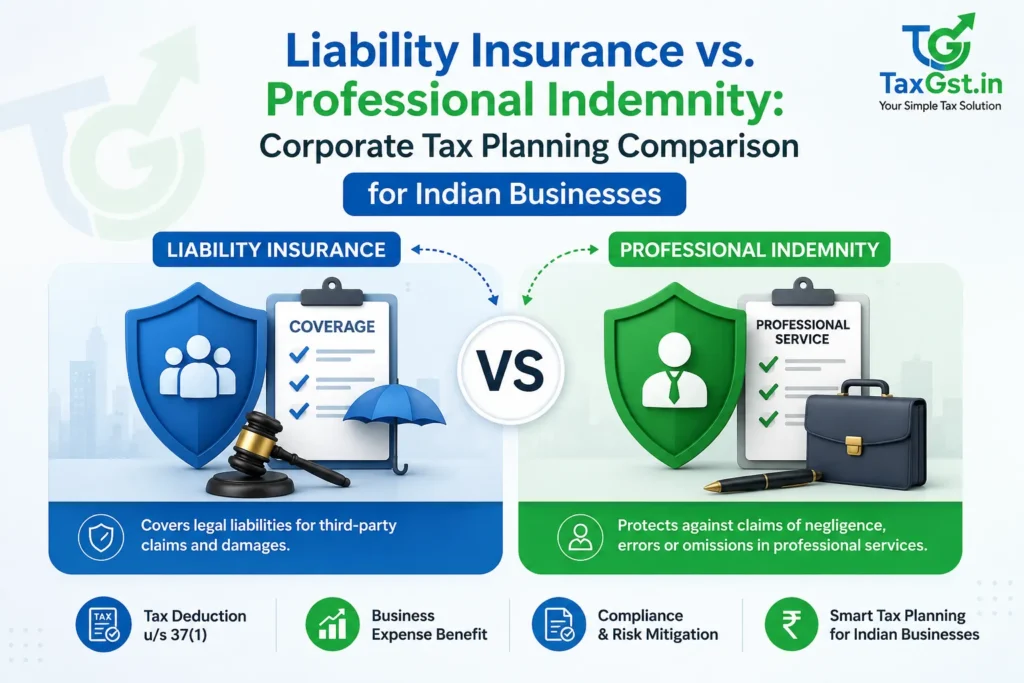
When a business pays for liability insurance or professional indemnity insurance, the premium is generally deductible as a business expense under Section 37(1) of the Income-tax Act, 1961, provided it is incurred wholly and exclusively for the purposes of business. However, the critical distinction lies in the nature of the policy, the timing of the deduction under Section 37 of the Income-tax Act, 2025 (formerly Section 43B), and whether the payment falls within the actual-payment window — making the tax treatment of these two insurance categories more nuanced than most businesses assume.
Quick Summary
- General liability insurance premiums are typically deductible under Section 37(1) as revenue expenditure, subject to the “wholly and exclusively for business” test.
- Professional indemnity insurance for CAs, lawyers, doctors, and other professionals is specifically recognised as a business necessity, with premiums deductible under the same residuary provision.
- Under Section 37 of the Income-tax Act, 2025 (corresponding to the old Section 43B), the timing of the deduction depends on when the premium is actually paid, not when the liability accrues.
- Businesses paying insurance premiums to micro or small enterprises must pay within the 15/45-day window under the MSME Act to avoid disallowance.
- The choice between old and new tax regimes affects the overall tax benefit, since Section 37(1) deductions are available under both regimes but interact differently with other provisions.
What Is the Tax Treatment of Liability Insurance Premiums for Indian Businesses?
When a company purchases general liability insurance — covering third-party bodily injury, property damage, or advertising injury claims — the premium paid is a classic revenue expenditure. It does not create any enduring asset; it merely protects the business against a recurring operational risk. This is precisely the type of expense that Section 37(1) of the Income-tax Act, 1961 was designed to cover as the residuary “catch-all” provision for business expenditure. The statutory test under Section 37(1) requires that the expenditure must not be covered by Sections 30 to 36, must not be capital or personal in nature, and must be laid out or expended wholly and exclusively for the purposes of business.
A general liability insurance premium satisfies all three limbs. It is not a capital expense because it does not create or acquire an asset. It is not personal because it protects the business entity, not an individual. And it is incurred wholly and exclusively for business because the policy exists solely to shield the company from operational risks. However, the deduction is not automatic. The Assessing Officer retains the power to examine whether the expenditure was genuinely incurred for business purposes. If a liability insurance policy is taken in the name of a director or promoter and primarily benefits that individual rather than the company, the deduction may be challenged. The substance-over-form doctrine applies — courts look at the commercial reality, not merely the documentation.
Under the new Income-tax Act, 2025, the equivalent provision continues to operate as a residuary clause. The structural consolidation of TDS provisions into Section 393 and the reorganisation of business deduction sections do not fundamentally alter the allowability of insurance premiums. What does change — and this is where many businesses get caught — is the timing rule under Section 37 of the new Act (corresponding to the old Section 43B), which mandates that certain specified payments are deductible only in the year of actual payment.
How Does Professional Indemnity Insurance Differ from General Liability Insurance for Tax Purposes?
Professional indemnity insurance occupies a unique position in the tax landscape because it is not merely a risk-mitigation tool — it is, for many professionals, a regulatory or practical prerequisite for carrying on their profession. Chartered accountants, lawyers, doctors, architects, engineers, and company secretaries all face claims of professional negligence, errors, and omissions. A single adverse claim can result in legal defence costs and compensation payments that could cripple a small or mid-sized practice.
From a tax perspective, the premium paid for professional indemnity insurance is treated identically to general liability insurance premium — it is a revenue deduction under Section 37(1). The policy does not create an enduring benefit; it provides coverage for a defined period. The fact that professional indemnity insurance may be effectively mandatory for a CA to retain a practising certificate does not convert it into a capital expenditure. The test remains whether the expenditure was incurred for the purpose of the business or profession, and professional indemnity insurance clearly meets that test.
The critical difference emerges in the context of Section 37 of the Income-tax Act, 2025 (formerly Section 43B). Under this provision, any sum payable by way of insurance premium — where the payee is a micro or small enterprise — must be paid within the time limit specified in Section 15 of the MSME Development Act, 2006 (15 days for goods, 45 days for services, or as per the agreed contract, whichever is earlier) to qualify for deduction in the year of liability. If the payment is delayed beyond this window, the deduction is denied in the year of accrual and allowed only in the year of actual payment.
This creates a planning consideration that is specific to professional indemnity insurance. Many professional indemnity policies are purchased from insurers who may or may not qualify as micro or small enterprises. If the insurer is an MSME, the professional or firm paying the premium must ensure timely payment to preserve the deduction. For large insurance companies (which are typically not MSMEs), this constraint does not apply, and the normal Section 37(1) timing rules govern.
Another dimension is the “excess” or “deductible” component of professional indemnity policies. CAs and other professionals often choose a higher excess to reduce their premium outflow. The excess amount — the portion of any claim that the insured bears themselves — is not an expenditure at the time of policy purchase. It becomes deductible only when a claim arises and the excess is actually paid. This is consistent with the actual-payment principle embedded in Section 37 of the new Act. The professional indemnity policy also covers legal defence costs, which can be substantial. These costs, whether paid directly by the insurer under the policy or borne by the professional and then claimed as a deduction, are allowable as business expenditure. The key documentation requirement is that the professional must maintain records showing that the legal costs were incurred in connection with a claim arising from professional services, not from personal or extraneous matters.
How Does the Actual-Payment Rule Under Section 37 of the Income-tax Act, 2025 Affect Insurance Premium Deductions?
The most consequential change for businesses paying insurance premiums is the mandatory actual-payment rule under Section 37 of the Income-tax Act, 2025, which corresponds to the erstwhile Section 43B of the Income-tax Act, 1961. This provision fundamentally alters the timing of deduction for specified expenditures, including insurance premiums payable to micro and small enterprises.
Under Section 37(1) of the new Act, any sum payable as specified in sub-section (2) — which includes amounts payable to micro or small enterprises — is allowed as a deduction only in the tax year in which such sums are actually paid, regardless of the method of accounting followed or the year in which the liability was incurred. This means that if a business recognises an insurance premium as an expense in its books of account for FY 2026-27 but does not actually pay the premium to an MSME insurer before the due date of filing the return of income under Section 263(1) for that year, the deduction will be denied for FY 2026-27 and allowed only in the year of actual payment.
The proviso to Section 37(3) provides a limited relief: amounts specified in clauses (a) through (f) of sub-section (2) — such as taxes, employer contributions to PF, and interest on loans — are allowed as deduction in the year of accrual if paid on or before the due date of filing the return. However, clause (g), which covers amounts payable to micro or small enterprises, is explicitly excluded from this relief. This means MSME insurance payments enjoy no such grace period — the deduction is available only in the year of actual payment, full stop.
For businesses, this creates a direct cash-flow-linked tax planning obligation. If your professional indemnity insurer is a micro or small enterprise — which is more common than many assume, especially for niche or regional insurers — you must pay the premium within the 15-day or 45-day window under Section 15 of the MSME Development Act, 2006, and in any event before the ITR due date, to secure the deduction for that year.
What Is the Difference in Tax Treatment Between Old and New Tax Regimes for Insurance Premiums?
Both the old and new tax regimes permit the deduction of insurance premiums under the residuary business expenditure provisions. However, the interaction of this deduction with other regime-specific provisions creates meaningful differences in the effective tax benefit.
Under the old regime, businesses can claim deductions under Section 37(1) alongside Chapter VI-A deductions such as Section 80C, 80D, and others. The standard deduction for salaried individuals under Section 16(ia) is Rs. 50,000. The old regime slabs — 0% up to Rs. 2.5 lakh, 5% from Rs. 2.5 to Rs. 5 lakh, 20% from Rs. 5 to Rs. 10 lakh, and 30% above Rs. 10 lakh — mean that the marginal tax benefit of an insurance premium deduction depends on the taxpayer’s income bracket.
Under the new regime under Section 115BAC, the standard deduction is Rs. 75,000, and the slabs are restructured: 0% up to Rs. 4 lakh, 5% from Rs. 4 to Rs. 8 lakh, 10% from Rs. 8 to Rs. 12 lakh, 15% from Rs. 12 to Rs. 16 lakh, 20% from Rs. 16 to Rs. 20 lakh, 25% from Rs. 20 to Rs. 24 lakh, and 30% above Rs. 24 lakh. The Section 87A rebate of Rs. 60,000 makes income up to Rs. 12 lakh tax-free under the new regime. However, most Chapter VI-A deductions, including Section 80C and 80D, are not available under the new regime.
The insurance premium deduction under Section 37(1) is available under both regimes because it is a business expenditure, not a Chapter VI-A deduction. This makes it particularly valuable under the new regime, where the pool of available deductions is significantly smaller. For a business operating under the new regime, the insurance premium deduction may be one of the few remaining avenues to reduce taxable business income. The following table summarises the key differences:
| Parameter | Old Regime (FY 2026-27) | New Regime (FY 2026-27) |
|---|---|---|
| Insurance premium deduction | Available under Section 37(1) | Available under Section 37(1) |
| Standard deduction (salaried) | Rs. 50,000 under Section 16(ia) | Rs. 75,000 under Section 16(ia) |
| Section 87A rebate | Rs. 12,500 (income up to Rs. 5 lakh) | Rs. 60,000 (income up to Rs. 12 lakh) |
| Chapter VI-A deductions (80C, 80D, etc.) | Available | Not available |
| MSME payment timing under Section 37 | Actual payment required for MSME dues | Actual payment required for MSME dues |
| Highest slab rate | 30% above Rs. 10 lakh | 30% above Rs. 24 lakh |
Worked Example: Tax Savings from Professional Indemnity Premium Under Both Regimes
Consider a chartered accountancy firm with a total business income of Rs. 30,00,000 for FY 2026-27. The firm pays a professional indemnity insurance premium of Rs. 1,50,000. The insurer is a large insurance company (not an MSME), so the actual-payment rule under Section 37(3) applies, and the premium is paid before the ITR due date.
Under the old regime, the firm claims the Rs. 1,50,000 premium as a deduction under Section 37(1), reducing taxable business income to Rs. 28,50,000. Assuming no other deductions, the tax liability is calculated as: 0% on first Rs. 2.5 lakh = Rs. 0; 5% on next Rs. 2.5 lakh = Rs. 12,500; 20% on next Rs. 5 lakh = Rs. 1,00,000; 30% on remaining Rs. 18.5 lakh = Rs. 5,55,000. Total tax before cess = Rs. 6,67,500. The effective tax saving from the Rs. 1,50,000 deduction is Rs. 45,000 (30% of Rs. 1,50,000, since the firm falls in the 30% bracket).
Under the new regime, the same Rs. 1,50,000 deduction reduces taxable income to Rs. 28,50,000.
- Tax is calculated as: 0% on first Rs. 4 lakh = Rs. 0;
- 5% on next Rs. 4 lakh = Rs. 20,000;
- 10% on next Rs. 4 lakh = Rs. 40,000;
- 15% on next Rs. 4 lakh = Rs. 60,000;
- 20% on next Rs. 4 lakh = Rs. 80,000;
- 25% on next Rs. 4 lakh = Rs. 1,00,000;
- 30% on remaining Rs. 4.5 lakh = Rs. 1,35,000.
- Total tax before cess = Rs. 4,35,000.
- The effective tax saving from the Rs. 1,50,000 deduction is Rs. 45,000 (30% of Rs. 1,50,000, since the firm also falls in the 30% bracket under the new regime).
In this example, the absolute tax saving is identical at Rs. 45,000 under both regimes because the firm’s income places it in the 30% bracket in both. However, the new regime’s lower overall tax liability — Rs. 4,35,000 versus Rs. 6,67,500 — means that the relative benefit of the deduction is smaller as a percentage of total tax. For firms in lower brackets, the new regime’s restructured slabs may result in a lower marginal benefit from the same deduction, making the choice of regime a critical planning variable.
What Documents Are Needed to Claim Insurance Premium Deductions Under Section 37(1)?
Claiming a deduction for liability insurance or professional indemnity insurance premiums is not merely about having a policy document. The Assessing Officer will examine whether the expenditure was genuinely incurred for business purposes, whether the premium was actually paid, and whether the payee is correctly classified. The following documents form the essential documentation backbone for a successful claim.
First, the insurance policy itself must clearly identify the insured entity as the business or professional, not as an individual. For a CA firm, the policy should be in the name of the firm or the practising individual in their professional capacity. If the policy is in the name of a partner or director personally, the deduction may be challenged as a personal expense rather than a business expense, even if the underlying risk relates to professional practice.
Second, the premium payment receipt or bank statement showing the actual date of payment is critical under Section 37 of the Income-tax Act, 2025. Since the deduction is allowed only in the year of actual payment for specified payees (including MSMEs), the payment date determines the year of deduction. A premium accrued but not paid by March 31 of the relevant tax year — or by the ITR due date under Section 37(3) of the new Act for non-MSME payees — will not qualify for deduction in that year.
Third, the invoice from the insurer must correctly classify the type of insurance. A professional indemnity policy should be distinctly identified as such, not bundled under a general commercial insurance heading. This classification matters because the tax treatment, while similar under Section 37(1), interacts differently with the actual-payment rule and the MSME payment timeline. If the insurer is a micro or small enterprise, the invoice must reflect this status, and the payment must be made within the 15/45-day window specified under Section 15 of the MSME Development Act, 2006.
Fourth, for professional indemnity insurance specifically, the professional should maintain a copy of their practising certificate or registration with the relevant professional body (ICAI, Bar Council, Medical Council, etc.). This establishes the nexus between the insurance premium and the professional practice. In the event of an assessment, the Assessing Officer may question whether a CA who has ceased active practice can continue to claim the professional indemnity premium as a business deduction. The practising certificate serves as evidence that the professional is actively engaged in practice and the insurance is a current business requirement.
Fifth, if the policy covers a multi-year period and the premium is paid upfront, the taxpayer must apportion the premium across the relevant tax years. The deduction is allowed proportionately for each year of coverage, not in full in the year of payment. This apportionment must be documented with a clear calculation showing the number of coverage days falling in each tax year. Failure to apportion correctly can lead to disallowance of the portion relating to future years.
Sixth, for businesses that have chosen a higher excess or deductible on their professional indemnity policy, the actual excess amount paid during the year in connection with a claim should be documented with the claim settlement letter, payment receipt, and correspondence with the insurer. The excess payment is a separate deductible expense and must be distinguished from the premium itself.
Who Is Eligible to Claim Professional Indemnity Insurance Premium as a Business Deduction?
The eligibility to claim professional indemnity insurance premium as a business deduction under Section 37(1) is not limited to a specific list of professions. Any person carrying on a business or profession who incurs expenditure on insurance that is wholly and exclusively for the purposes of that business or profession can claim the deduction. However, the practical application varies significantly across categories of taxpayers.
Chartered accountants, whether practising individually or as a firm, are the most common claimants. The Institute of Chartered Accountants of India (ICAI) strongly recommends professional indemnity insurance for all practising CAs, and the premium is universally accepted as a legitimate business expense. For CA firms, the policy is typically taken in the firm’s name, and the premium is deducted from the firm’s income. For individual practitioners, the premium is deducted from their professional income under the head “Profits and gains of business or profession.”
Lawyers and law firms follow a similar pattern. The Bar Council of India does not mandate professional indemnity insurance for all advocates, but many state bar councils and the Supreme Court have encouraged or required it. The tax treatment is identical — the premium is a revenue deduction under Section 37(1).
Doctors, surgeons, and medical professionals face an increasing risk of medical negligence claims. Professional indemnity insurance for doctors covers claims arising from errors in diagnosis, treatment, or surgical procedures. The premium is deductible as a business expense for doctors running their own practice. For doctors employed in hospitals, the situation is different — if the hospital pays the premium, the hospital claims the deduction. If the doctor pays the premium personally and the hospital does not reimburse it, the doctor may still claim it as a deduction against their professional income, provided they can demonstrate that the insurance is necessary for their practice.
Architects, engineers, and company secretaries also claim professional indemnity premiums as business deductions. The principle is the same: the insurance must be for the purpose of the profession, not for personal benefit. For companies and LLPs that engage professionals, the situation requires careful analysis. If a company takes a professional indemnity policy covering its directors or employees who provide professional services to clients, the premium is a deductible business expense for the company. However, if the policy primarily benefits a specific individual — say, a managing director who provides personal professional services — the Assessing Officer may argue that the expenditure is personal in nature and disallow the deduction. The key is to demonstrate that the policy protects the business entity’s exposure, not an individual’s personal liability.
Businesses operating in sectors with mandatory insurance requirements — such as insurance companies, stockbrokers, and NBFCs — also claim professional indemnity or errors-and-omissions insurance premiums. Under Section 55 read with Part B of Schedule XIV of the Income-tax Act, 2025, the computation of profits and gains for non-life insurance businesses follows a specific manner, and any amount inadmissible under Sections 28 to 54 is added back. However, genuine professional indemnity premiums paid by such businesses are generally allowable as revenue expenditure, subject to the specific computation rules applicable to insurance businesses.
The eligibility also extends to businesses that purchase general liability insurance — covering public liability, product liability, or employer’s liability. The same Section 37(1) test applies: the expenditure must be wholly and exclusively for business purposes. A manufacturing company purchasing product liability insurance, for instance, can claim the premium as a deduction. A retailer purchasing public liability insurance for their premises can do the same. The nature of the insurance does not change the legal test; it only changes the risk being mitigated.
One important caveat: under the new tax regime under Section 115BAC of the Income-tax Act, 1961 (and its equivalent under the new Act), most Chapter VI-A deductions are not available. However, Section 37(1) deductions — including insurance premiums — are business expenditure deductions, not Chapter VI-A deductions. They are available under both the old and new tax regimes. This means that a professional opting for the new regime can still claim their professional indemnity insurance premium as a deduction against their business income. The standard deduction of Rs. 75,000 available under the new regime for salaried individuals (as per the section-wise deduction table) is separate from and does not affect the Section 37(1) business deduction for insurance premiums.
How Do Liability Insurance and Professional Indemnity Premiums Compare for Tax Deduction Purposes?
Both general liability insurance and professional indemnity insurance premiums are deductible under Section 37(1) of the Income-tax Act, 1961 as revenue expenditure. However, the practical tax treatment diverges when the actual-payment rule under Section 37 of the Income-tax Act, 2025 (formerly Section 43B) is triggered. The key variable is the status of the payee — specifically, whether the insurer qualifies as a micro or small enterprise under the MSME Act. The comparison below highlights the critical differences that Indian businesses must evaluate when planning their insurance-related tax deductions.
| Parameter | General Liability Insurance | Professional Indemnity Insurance |
|---|---|---|
| Nature of Coverage | Third-party bodily injury, property damage, advertising injury | Professional negligence, errors, omissions, misconduct claims from clients |
| Tax Section for Deduction | Section 37(1) of the Income-tax Act, 1961 | Section 37(1) of the Income-tax Act, 1961 |
| Capital vs Revenue | Revenue expenditure — no enduring asset created | Revenue expenditure — no enduring asset created |
| Actual-Payment Rule (Sec 37 of new Act) | Applies only if insurer is an MSME — payment within 15/45 days required | Applies only if insurer is an MSME — payment within 15/45 days required |
| Excess/Deductible Component | Not separately relevant — premium is the deductible amount | Excess is deductible only when actually paid upon a claim, not at policy inception |
| Legal Defence Costs | Covered under the policy; insurer pays directly | Covered under the policy; may be paid by insurer or by professional and then claimed |
| Regulatory Requirement | Not mandatory for most businesses (contractual requirement may apply) | Effectively mandatory for CAs, lawyers, doctors to retain practising credentials |
| Documentation Risk | Moderate — invoice and policy sufficient | Higher — must prove claim arose from professional services, not personal matters |
What Is the Financial Impact of Choosing the Wrong Insurance Type on Your Tax Liability?
Consider a practical example. A Delhi-based consulting firm with annual profits of Rs. 50,00,000 purchases both general liability insurance (premium Rs. 1,20,000) and professional indemnity insurance (premium Rs. 80,000) in March 2026 for the policy year April 2026 to March 2027. The firm follows the mercantile system of accounting and accrues the entire premium as an expense in FY 2026-27. Both insurers are large public sector companies and not MSMEs. Under Section 37(1) of the Income-tax Act, 1961, the total insurance premium of Rs. 2,00,000 is allowable as a revenue deduction in FY 2026-27, since the liability has been incurred and the payees are not MSMEs. The actual-payment rule PDF under Section 37 of the Income-tax Act, 2025 does not apply here because the insurers are not micro or small enterprises. The firm’s taxable profit reduces from Rs. 50,00,000 to Rs. 48,00,000. At the corporate tax rate of 25%, the tax saving is Rs. 50,000.
Now consider the same scenario, but with the professional indemnity premium of Rs. 80,000 payable to a micro enterprise. If the firm pays this premium on June 20, 2026 — which is 16 days after the policy inception on April 5, 2026 — and the agreed payment terms under the contract stipulate 30 days, the payment is within the 45-day window specified under Section 15 of the MSME Act. The deduction is preserved in FY 2026-27. However, if the firm delays payment to August 15, 2026 — beyond 45 days — the Rs. 80,000 deduction is denied in FY 2026-27 and allowed only in the year of actual payment, which could be FY 2027-28. This deferral increases the firm’s tax liability for AY 2027-28 by Rs. 20,000 (25% of Rs. 80,000).
What Are the Key Pitfalls When Claiming TDS and Deduction on Insurance Premiums Under the New Income-tax Act, 2025?
The Income-tax Act, 2025, which came into force on April 1, 2026, consolidates all non-salary TDS obligations into a single Section 393, replacing the old 194-series with 92 numeric payment codes. This structural overhaul has direct implications for businesses paying insurance premiums, particularly professional indemnity premiums to chartered accountants, lawyers, and other professionals.
Under the new Act, the old Section 194J has been split into three distinct codes within Section 393: Code 1026 for fees for technical services at 2%, Code 1027 for fees for professional services at 10%, and Code 1028 for director’s remuneration at 10%. A business that engages a chartered accountant for professional services and pays a fee must deduct TDS at 10% under Code 1027. If the business erroneously selects Code 1026 (2%) instead of Code 1027 (10%), the TDS shortfall is 8 percentage points. This triggers a severe consequence under Section 35(b) of the new Act (corresponding to the old Section 40(a)(ia)), which provides that 30% of any sum payable to a resident on which tax was deductible but not deducted shall be disallowed while computing profits and gains of business or profession.
For a business paying Rs. 10,00,000 as professional fees to a CA, the 30% disallowance would amount to Rs. 3,00,000 — a disproportionate penalty for what is, in substance, an 8% TDS shortfall. The protective judicial precedents under the old Act, which held that TDS deducted under a wrong section does not trigger disallowance, may not survive transplantation to the new Act, given the structural consolidation of all TDS within a single Section 393 and the newly binding force of CBDT circulars under Section 400(2). This risk is amplified by the fact that the definition of “work” has been extended to include “supply of manpower” under section 402(27) of the Income-tax Act, 2025, further expanding the scope of TDS obligations.
Businesses must also be cautious about the classification of insurance premium payments themselves. If a professional indemnity policy is structured as part of a composite service agreement with a CA or law firm, the TDS treatment of the entire payment — including the insurance component — must be carefully analysed. The CBDT must urgently issue a formal circular under Section 400(2) addressing the Section 35(b) consequences of code selection errors, particularly for Code 1026 vs. Code 1027 misclassifications. Until such guidance is issued, deductors should update their vendor classification master to map each vendor and payment type to the correct code, supported by a documented basis for that classification.
How Should Businesses Plan Their Insurance Purchases to Maximise Tax Deductions Under Both Regimes?
The choice between the old and new tax regimes affects the overall tax benefit of insurance premium deductions, even though Section 37(1) deductions are available under both regimes. Under the old regime, businesses can claim the full range of deductions under Sections 80C to 80G, which may reduce taxable income to a level where the effective tax rate is lower than the new regime’s flat slabs. Under the new regime, the lower tax slabs may already place the business in a lower bracket, making the incremental benefit of insurance premium deductions less significant in absolute terms.
Under the new tax regime for FY 2026-27, the slabs are: 0-4L = 0%, 4-8L = 5%, 8-12L = 10%, 12-16L = 15%, 16-20L = 20%, 20-24L = 25%, and above 24L = 30%. The Section 87A rebate of Rs. 60,000 makes income up to Rs. 12 lakh effectively tax-free under the new regime. A business with profits of Rs. 12,00,000 or less may find the new regime more attractive, as the insurance premium deduction under Section 37(1) provides marginal additional benefit. However, a business with profits significantly above Rs. 12,00,000 — where the 25% or 30% slab applies — may derive meaningful tax savings from insurance premium deductions under either regime.
The critical planning consideration is the actual-payment timing under Section 37 of the Income-tax Act, 2025. For any insurance premium payable to a micro or small enterprise, the business must ensure payment within the 15/45-day window to preserve the deduction in the year of accrual. This requires a robust accounts payable process that flags MSME vendors and tracks payment deadlines. The ITR due date benefit under Section 37(3) of the new Act — which allows deduction in the year of accrual if payment is made before the ITR filing due date — does not apply to MSME payments under clause (g). This is a common source of disallowance that businesses must guard against.
Additionally, businesses should evaluate whether their professional indemnity policy includes a “run-off cover” extension, which covers claims made after the policy period for services rendered during the policy period. The premium for run-off cover is also deductible under Section 37(1) as revenue expenditure, provided the actual-payment rule is satisfied. The documentation requirement is that the run-off cover must be clearly identified in the policy and the premium must be separately ascertainable.
What Are the Key Documentation Requirements for Claiming Insurance Premium Deductions?
Claiming a deduction for liability insurance or professional indemnity insurance is not merely about having the policy document. The Assessing Officer will examine whether the expenditure was genuinely incurred for business purposes, whether the premium was actually paid, and whether the payee is correctly classified. Meticulous documentation is the first line of defence in any scrutiny assessment. The following documents should be maintained for every insurance premium claim:
- The insurance policy document showing the coverage period, sum insured, and named insured entity.
- Premium payment receipt or bank statement showing the actual date of payment — this is critical under the Section 37 actual-payment rule.
- Invoice from the insurer or insurance intermediary, clearly stating the GST amount and premium amount separately.
- MSME registration certificate of the insurer, if applicable, to determine whether the 15/45-day payment rule applies.
- A board resolution or partnership deed authorisation showing that the premium was incurred for business purposes, not for the personal benefit of any individual.
- For professional indemnity policies, the practising certificate or registration of the professional, demonstrating the nexus between the insurance and the professional practice.
What Should You Do Next?
- Review all professional indemnity and general liability insurance policies to confirm whether the insurer is registered as a micro or small enterprise under the MSME Act — this determines whether the 15/45-day payment rule applies.
- Map each insurance premium payment to the correct TDS code under Section 393 of the Income-tax Act, 2025 — using Code 1026 instead of Code 1027 for professional services can trigger an 8% shortfall and potential 30% disallowance under Section 35(b).
- Update your vendor classification master to distinguish between technical service providers (Code 1026, 2%) and professional service providers (Code 1027, 10%), especially for payments to CAs, lawyers, doctors, and engineers.
- Ensure that any insurance premium payable to an MSME insurer is settled within the statutory time limit specified in Section 15 of the MSME Act — for services, this is 45 days from the date of acceptance or the agreed payment date, whichever is earlier.
- Maintain separate documentation for excess or deductible amounts under professional indemnity policies, as these become deductible only when a claim arises and the excess is actually paid — not at the time of policy purchase.
- If you have paid a settlement or compensation amount arising from a professional negligence claim, verify whether the payment qualifies as compensatory (allowable under Section 37(1)) or penal (disallowable under Explanation 1 read with Explanation 3), particularly in light of Notification No. 38/2025 dated April 23, 2025 which lists the laws covered under the newly inserted clause (iv) to Explanation 3.
- Before filing your TDS returns for Q1 of Tax Year 2026-27 (due in July 2026), reconcile all insurance premium challans against the correct Section 393 payment codes and confirm that TDS has been deducted and deposited at the applicable rate — a wrong code selection within the consolidated Section 393 framework carries higher risk than under the old 194-series structure.
Frequently Asked Questions
Is professional indemnity insurance premium deductible under both the old and new tax regimes?
Yes. Professional indemnity insurance premium is deductible as a business expense under Section 37(1) of the Income-tax Act, 1961 (and the corresponding provision under the Income-tax Act, 2025) in both the old and new tax regimes. The premium is a revenue expenditure — it does not create an enduring asset and is incurred wholly and exclusively for the purpose of the profession. The critical condition is that the payment must comply with the actual-payment rule under Section 37 of the new Act if the insurer is a micro or small enterprise, meaning the premium must be paid within the 15/45-day window to qualify for deduction in the year of accrual.
What happens if I pay my professional indemnity insurance premium after the MSME payment deadline?
If the insurer is a micro or small enterprise and the premium is paid beyond the time limit specified in Section 15 of the MSME Development Act, 2006 — 15 days for goods or 45 days for services (or the agreed contract date, whichever is earlier) — the deduction is denied in the year in which the liability accrued. Under Section 37(3) of the Income-tax Act, 2025, the deduction is allowed only in the tax year in which the sum is actually paid. Unlike other specified payments under Section 37(2)(a) through (f), the ITR due-date benefit does not apply to MSME payments under clause (g). This means even if you pay before the ITR filing deadline, the deduction shifts to the year of actual payment if the statutory MSME timeline was breached.
Can a settlement payment to resolve a professional negligence claim be disallowed as a business expense?
It depends on the nature of the payment. A compensatory settlement payment made to resolve a civil dispute — such as a claim for professional negligence — is generally allowable under Section 37(1) if it is incurred for commercial expediency and to protect business interests. However, Explanation 1 read with Explanation 3 to Section 37(1) disallows any expenditure incurred for a purpose that is an offence or prohibited by law, or to compound an offence under a law notified by the Central Government. Under Notification No. 38/2025 dated April 23, 2025, the CBDT has notified specific laws for the purposes of clause (iv) to Explanation 3. If the settlement relates to a contravention of a law listed in that notification, the expenditure is disallowed. If the law is not so notified — as was held in the case of patent disputes where the Patent Act was absent from the list — the settlement payment remains deductible as a compensatory business expense.
Does using the wrong TDS code under Section 393 for an insurance premium payment trigger disallowance of the entire expenditure?
Potentially, yes — and this is a significant risk under the new Act. Section 35(b) of the Income-tax Act, 2025 provides that 30% of any sum payable to a resident, on which tax was deductible but not deducted or not deposited by the due date of filing the return under Section 423(1), shall be disallowed. Under the old Act, courts had consistently held that TDS deducted under the wrong section did not trigger Section 40(a)(ia) disallowance because different sections represented different legislative intents. However, under the new Act, all TDS obligations are consolidated into a single Section 393 with 92 numeric payment codes. Selecting Code 1026 (2%, technical services) instead of Code 1027 (10%, professional services) for a payment to a chartered accountant results in an 8% shortfall in TDS. Given that CBDT circulars under Section 400(2) are now binding on deductors, the old ‘bona fide possible view’ defence may not survive. The protective proviso — that no disallowance applies if the deductee has included the income and paid the tax — offers only partial protection unless the deductee has independently covered the 8% shortfall through advance tax.
Sources
- TaxGuru — Professional Indemnity Insurance for Chartered Accountants
- Income Tax India — FAQs Budget 2026
- TaxGuru — Section 37 Business Expenditure Deduction and Case Law
- TaxGuru — Wrong TDS Code Under Income Tax Act 2025 Can Trigger 30% Disallowance
- TaxGuru — Section 37 of Income Tax Act 2025 (Earlier Section 43B)
Need help with your insurance premium tax planning? Every business has a unique risk profile, and the tax treatment of your insurance costs depends on the specific policies you hold, the insurers you use, and the timing of your payments. Speak with a qualified tax professional to ensure you are claiming every rupee of deduction you are entitled to — without triggering disallowance risks. Book a consultation today and file your AY 2027-28 return with confidence.
Article Information
Published: June 9, 2026
Last Reviewed: June 9, 2026
Category: Insurance
Regulatory Body: Insurance Regulatory and Development Authority of India (IRDAI)
Written by C.K. Gupta, M.Com & Tax Editor at TaxGST.in — helping readers understand IRDAI regulations, insurance policy terms, and claim procedures since 2009.
Official Resources
Disclaimer: This article is for informational purposes only. Insurance policy terms, IRDAI regulations, and claim procedures may change. Always verify current details on the IRDAI website and your policy document. Consult a licensed insurance advisor for personalized advice.
Discover more from TaxGst.in
Subscribe to get the latest posts sent to your email.




Stay Updated!
Join our community for latest tax updates, GST news & finance tips