
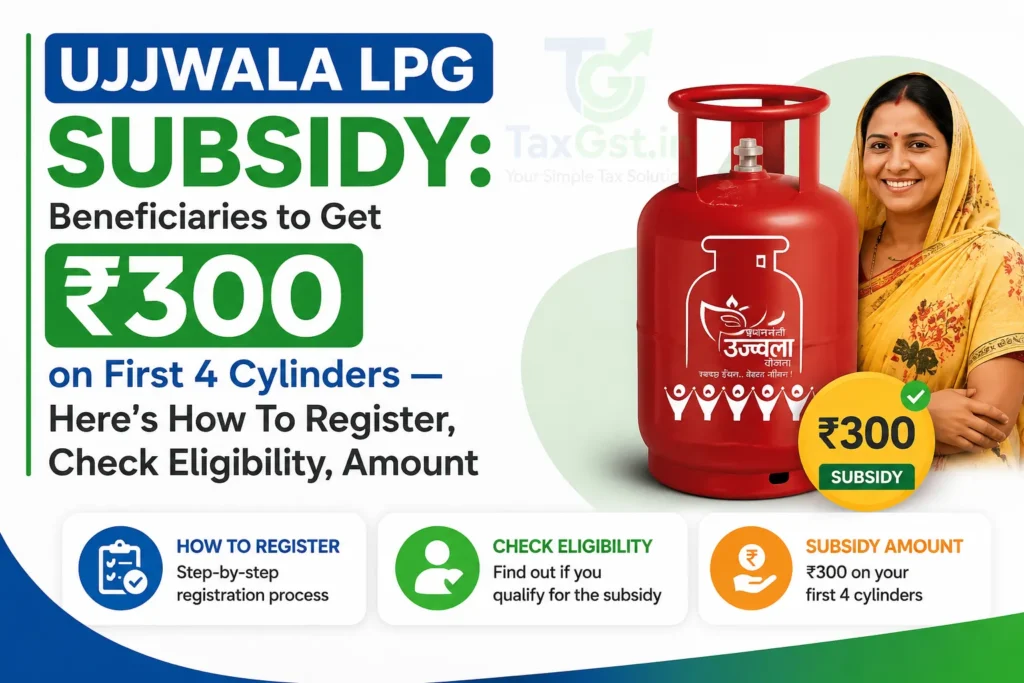
Under the Pradhan Mantri Ujjwala Yojana (PMUY), eligible beneficiaries currently receive a targeted subsidy of Rs 300 per 14.2 kg LPG cylinder for up to 12 refills per year (and proportionately for 5 kg cylinders), as confirmed by the Cabinet decision for FY 2025-26. However, recent reports indicate the government is considering restricting this subsidy to the first four cylinders per year, though the existing Rs 12,000 crore annual subsidy budget continues to apply. The effective price for PMUY consumers in Delhi is Rs 503 per cylinder against the market price of Rs 803.
Also Read-Govt Scheme: PM Vishwakarma Yojana (PMVY)
Quick Summary
- PMUY provides deposit-free LPG connections to adult women from poor households across India.
- Over 10.33 crore active PMUY beneficiaries currently receive the targeted subsidy.
- The current subsidy is Rs 300 per 14.2 kg cylinder, available for up to 12 refills annually.
- Reports suggest a proposed reduction to the first 4 cylinders per year for the subsidy benefit.
- Per capita LPG consumption among PMUY beneficiaries has risen from 3.01 cylinders (FY 2019-20) to 4.43 cylinders (FY 2024-25).
- India imports approximately 60% of its domestic LPG, and international price volatility directly impacts consumer costs.
What Is the PMUY LPG Subsidy and How Has It Evolved?
The Pradhan Mantri Ujjwala Yojana (PMUY) was launched on May 1, 2016, from Ballia district in Uttar Pradesh by Prime Minister Narendra Modi with the objective of providing deposit-free LPG connections to adult women from poor households. The scheme initially targeted 5 crore families but was expanded to 8 crore connections, achieving this milestone in September 2019. Subsequently, Ujjwala 2.0 was launched in August 2021 with an additional target of 1 crore connections, later expanded by 60 lakh more, and a further 75 lakh connections were approved for the period FY 2023-24 to 2025-26, all of which have been achieved as of July 2024.
The targeted subsidy component was introduced in May 2022, when the government began providing Rs 200 per 14.2 kg cylinder for up to 12 refills per year (and proportionately for 5 kg cylinders). In October 2023, this subsidy was increased to Rs 300 per cylinder. As per the Cabinet decision for FY 2025-26, the Rs 300 per cylinder subsidy continues with an annual budget allocation of Rs 12,000 crore. However, recent media reports from June 2026 indicate that the government is considering restricting the subsidy to the first four cylinders per year instead of twelve, though this change has not yet been formally notified through an official gazette or press release.
Also Read-ITR Filing for a Deceased Taxpayer: Section 291 Rules, Legal Heir Registration & Compliance Guide
How Much Subsidy Do PMUY Beneficiaries Actually Receive?
The subsidy mechanism works through a combination of direct price reduction and Direct Benefit Transfer (DBT). The retail selling price of a 14.2 kg domestic LPG cylinder in Delhi is currently Rs 803. After the targeted subsidy of Rs 300 per cylinder, PMUY consumers pay an effective price of Rs 503 per cylinder in Delhi. This represents a 44% reduction from the Rs 903 price that prevailed in August 2023, demonstrating the government’s commitment to shielding PMUY beneficiaries from international price volatility.
India imports approximately 60% of its domestic LPG, and the price is linked to international benchmarks. While the average Saudi CP (international benchmark for LPG pricing) rose by 63% from US$385/MT in July 2023 to US$629/MT in February 2025, the effective price for PMUY consumers was reduced by 44% during the same period. The subsidy is transferred to beneficiaries through Aadhaar Transfer Compliant (ATC) or Bank Transfer Compliant (BTC) modes under the PAHAL (DBTL) scheme framework. Consumers purchase cylinders at the market price and the subsidy amount is credited directly to their linked bank account.
The per capita consumption of PMUY beneficiaries has shown consistent improvement, rising from 3.01 cylinders per year in FY 2019-20 to 3.68 in FY 2021-22, 3.95 in FY 2023-24, and reaching 4.43 cylinders in FY 2024-25. This upward trend indicates that sustained affordability measures are enabling beneficiaries to move beyond mere adoption toward regular LPG usage for cooking needs.
What Is the Current Subsidy Structure and Proposed Change for FY 2026-27?
As per the Cabinet decision for FY 2025-26, PMUY beneficiaries receive a targeted subsidy of Rs 300 per 14.2 kg LPG cylinder for up to 12 refills per year (and proportionately for 5 kg cylinders), with an annual budget allocation of Rs 12,000 crore. However, reports published on June 9, 2026, indicate that the government is considering restricting this subsidy to the first four cylinders per year. If implemented, this would mean a PMUY household would receive the Rs 300 subsidy on cylinders 1 through 4, and pay the full market price for cylinders 5 through 12. The existing Rs 12,000 crore annual subsidy budget is expected to continue, which suggests the savings from the reduced cylinder count may be redirected to cover more beneficiaries or increase the per-cylinder subsidy amount.
The table below compares the current and proposed subsidy structures for a typical PMUY household consuming 14.2 kg cylinders.
| Parameter | Current Structure (FY 2025-26) | Proposed Structure (FY 2026-27) |
|---|---|---|
| Subsidy per 14.2 kg cylinder | Rs 300 | Rs 300 (on first 4 cylinders) |
| Maximum subsidised refills per year | 12 cylinders | 4 cylinders |
| Annual subsidy per beneficiary (max) | Rs 3,600 (12 x Rs 300) | Rs 1,200 (4 x Rs 300) |
| Price paid by beneficiary — cylinders 1 to 4 | Rs 503 per cylinder (Delhi) | Rs 503 per cylinder (Delhi) |
| Price paid by beneficiary — cylinders 5 to 12 | Rs 503 per cylinder (Delhi) | Rs 803 per cylinder (Delhi, full market price) |
| Annual cost to beneficiary (at 4.43 cylinders/year) | Rs 2,228 (4.43 x Rs 503) | Rs 2,228 (4.43 x Rs 503, within first 4) |
| Annual cost to beneficiary (at 8 cylinders/year) | Rs 4,024 (8 x Rs 503) | Rs 5,424 (4 x Rs 503 + 4 x Rs 803) |
| Annual subsidy budget | Rs 12,000 crore | Rs 12,000 crore (expected to continue) |
Consider a PMUY household in Delhi that consumes 8 cylinders per year. Under the current structure, the household pays Rs 503 per cylinder for all 8 cylinders, totalling Rs 4,024 annually, with Rs 2,400 received as subsidy (8 x Rs 300). Under the proposed structure, the household would pay Rs 503 for the first 4 cylinders and Rs 803 for the next 4 cylinders, totalling Rs 5,424 annually, with only Rs 1,200 received as subsidy (4 x Rs 300). This represents an additional annual burden of Rs 1,400 for households consuming more than 4 cylinders per year. However, for households consuming 4.43 cylinders per year (the current average for PMUY beneficiaries as per FY 2024-25 data), the impact would be minimal since the average consumption falls within the first four cylinders.
It is important to note that the proposed change has not yet been formally notified through an official gazette or press release as of June 9, 2026. The existing Rs 300 per cylinder subsidy for up to 12 refills remains in effect until a formal notification is issued. Beneficiaries should monitor the official PMUY portal at www.pmuy.gov.in and the Press Information Bureau (PIB) announcements for any official confirmation of the revised subsidy structure.
Who Is Eligible for the PMUY ₹300 Per Cylinder Subsidy?
Eligibility for the PMUY subsidy is determined at the time of connection issuance and is based on specific socio-economic criteria. The scheme targets adult women from poor households who do not already have an LPG connection in the family. Once a connection is issued under PMUY, the beneficiary continues to receive the targeted subsidy on refills as long as the connection remains active and the subsidy policy remains in force.
The following categories of households are eligible for PMUY connections and the associated refill subsidy, as per the scheme guidelines issued by the Ministry of Petroleum and Natural Gas.
| Eligibility Category | Details |
|---|---|
| Applicant must be an adult woman | The applicant must be a woman above the age of 18 years. The connection is issued in the name of the adult woman in the household. |
| SECC 2011 listed households | Households identified in the Socio Economic Caste Census (SECC) 2011 database are the primary target group. |
| SC/ST households | All Scheduled Caste and Scheduled Tribe households without an existing LPG connection are eligible. |
| PMAY (Gramin) beneficiaries | Beneficiaries of the Pradhan Mantri Awas Yojana (Gramin) who do not have an LPG connection. |
| Antyodaya Anna Yojana (AAY) | Households holding AAY ration cards, representing the poorest of the poor. |
| Forest Dwellers | Households classified as forest dwellers without an existing LPG connection. |
| Most Backward Classes (MBC) | Households identified as Most Backward Classes in the respective state lists. |
| Tea and Ex-Tea Garden Tribes | Residents of tea and ex-tea garden areas belonging to identified tribal communities. |
| Island and River Island residents | Residents of islands and river islands without access to LPG. |
| Poor households under 14-point declaration | Households that do not meet any of the above criteria but are identified as poor through a 14-point declaration. |
| No existing LPG connection | The applicant’s household must not already own an LPG connection in any family member’s name. De-duplication is done electronically through the OMC portal. |
| Savings bank account required | The applicant must have a savings bank account in any nationalised bank to receive the subsidy amount through Direct Benefit Transfer. |
As per the PIB factsheet dated November 2, 2021, the scheme has been extended to people residing in hilly states, including North-Eastern states, by treating them as priority states. The de-duplication exercise is conducted electronically by Oil Marketing Companies (OMCs) to ensure that no household with an existing LPG connection receives a second connection under PMUY.
What Documents Are Needed to Apply for a New PMUY Connection?
Applying for a new PMUY connection requires a set of standard KYC documents to verify the applicant’s identity, address, and BPL status. The documentation process has been simplified over the years, and applicants can now apply online through the PMUY portal at www.pmuy.gov.in or visit their nearest LPG distributor. The following documents are required for a new PMUY connection application.
| Document Type | Accepted Documents | Remarks |
|---|---|---|
| Identity Proof (any one) | Aadhaar Card, Voter ID, Passport, Driving Licence, PAN Card | Aadhaar is preferred as it enables seamless DBT linkage and de-duplication. |
| Address Proof (any one) | Aadhaar (with current address), Ration Card, Electricity Bill, Water Bill, Telephone Bill, Rent Agreement | Address should match the location where the connection is sought. |
| BPL Status Proof | BPL Ration Card, Authorised BPL Certificate (from Panchayat Pradhan or Municipality Chairman) | Required to establish eligibility under the BPL category. |
| Passport-size photograph | Recent passport-size photograph of the applicant woman | Required for the application form and connection record. |
| Bank Account details | Bank account number, IFSC code, passbook copy | Must be a savings account in the applicant’s name for DBT subsidy transfer. |
| Aadhaar-Bank linkage proof | Evidence that Aadhaar is linked to the bank account | Essential for receiving subsidy through Aadhaar Transfer Compliant (ATC) mode. |
For migrant families who may not have a permanent address proof, the PMUY scheme provides an option to avail a new connection on self-declaration instead of requiring proof of address and a ration card. This provision was introduced to ensure that migrant workers and their families are not excluded from the scheme due to documentation challenges. As per the PIB press release dated July 1, 2024, over 30.19 crore LPG consumers are registered under the PAHAL scheme, with subsidy transferred through ATC or BTC modes.
Applicants who do not have an Aadhaar card at the time of application can still apply. The OMC officials coordinate with UIDAI to facilitate Aadhaar enrolment for such applicants. Similarly, if the applicant does not have a bank account, the OMC facilitates opening of a bank account under the Jan Dhan Yojana framework. The entire application process, including document verification, is designed to be completed within a few days, and the LPG connection is typically installed within 4 to 5 business days after verification, as per the standard process followed by Bharat Gas distributors.
How Does PMUY Subsidy Compare With General PAHAL DBT Subsidy?
The PMUY targeted subsidy operates alongside the broader PAHAL (Direct Benefit Transfer for LPG) scheme, which applies to all domestic LPG consumers. Understanding the distinction is critical because the two mechanisms differ in both quantum and delivery. Under the PAHAL scheme, as implemented from July 1, 2024, non-PMUY consumers purchase LPG cylinders at the market price and receive the applicable subsidy directly in their bank accounts through Aadhaar-based DBT. The subsidy amount under PAHAL varies based on international LPG prices and is subject to periodic revision by the government. In contrast, PMUY beneficiaries receive a fixed per-cylinder subsidy of Rs 300 (currently for up to 12 refills, with reports of a proposed reduction to 4 refills), which functions as a targeted benefit on top of the general PAHAL framework.
The table below compares the two subsidy mechanisms for a PMUY household in Delhi purchasing a 14.2 kg cylinder.
| Parameter | PMUY Targeted Subsidy | General PAHAL DBT Subsidy (Non-PMUY) |
|---|---|---|
| Nature of subsidy | Fixed per-cylinder amount for eligible beneficiaries | Variable amount linked to international LPG price |
| Current subsidy per 14.2 kg cylinder (Delhi) | Rs 300 (up to 12 refills/year, proposed reduction to 4) | Varies — credited as DBT after purchase at market rate |
| Eligibility | Adult women from poor households as per SECC 2011 and other specified categories | All domestic LPG consumers with Aadhaar-linked bank account |
| Delivery mechanism | Effective price reduction at point of sale + DBT for some components | Full market price paid upfront; subsidy credited to bank account later |
| Annual budget allocation | Rs 12,000 crore (as per Cabinet decision for FY 2025-26) | Merged under overall LPG subsidy budget of the Government of India |
| Deposit-free connection | Yes — Rs 1,600 financial assistance per connection | No — security deposit payable as per OMC norms |
| Maximum refills eligible for subsidy | 12 per year (proposed reduction to 4) | No fixed cap — subsidy applies to all refills at applicable rate |
The PMUY subsidy is therefore significantly more generous for low-income households compared to the general PAHAL mechanism, both in terms of the fixed per-cylinder benefit and the deposit-free connection. However, the proposed restriction to 4 cylinders per year, if implemented, would narrow this gap for higher-consuming PMUY households while preserving the benefit for the majority of beneficiaries whose average consumption stands at 4.43 cylinders per year as per FY 2024-25 data.
What Are the Common Reasons for Subsidy Rejection and How Can Beneficiaries Avoid Them?
Despite the streamlined DBT mechanism, PMUY beneficiaries may face delays or rejection of subsidy disbursement due to several common issues. The most frequent cause is Aadhaar-bank account linkage failure — if the Aadhaar number registered with the LPG connection does not match the Aadhaar linked to the bank account, the DBT transfer fails. Beneficiaries should verify that their Aadhaar is uniformly linked across both the LPG consumer record and the bank account by checking with their LPG distributor and bank branch.
A second common reason is de-duplication failure. When multiple connections are registered against the same Aadhaar or the same bank account, the system flags the record for manual verification, causing delays. Each household should hold only one PMUY connection, and the beneficiary name on the Aadhaar card, ration card, and bank account must be identical. Spelling variations — for example, ‘Lakshmi’ on Aadhaar versus ‘Lakshmi Devi’ on the bank account — can trigger rejection.
Additionally, beneficiaries who have migrated from their original address of connection issuance may face subsidy disbursement issues if they have not updated their distributor records. Migrant families can avail a new connection on self-declaration instead of proof of address and ration card, as per the simplified process introduced under PMUY. However, the original connection must be formally surrendered to avoid duplicate connection flags. Beneficiaries should also ensure their bank account is active and not frozen, as inactive accounts cannot receive DBT credits.
A worked example illustrates the verification process. Consider a PMUY beneficiary in Jaipur whose Aadhaar number is 1234-5678-9012. The LPG connection is registered under this Aadhaar with HP Gas distributor ‘Sharma Gas Agency’. The beneficiary’s bank account at State Bank of India has the Aadhaar linked as 1234-5678-9012. When the beneficiary purchases a 14.2 kg cylinder at the market price of Rs 803, the system matches the Aadhaar on the LPG connection with the Aadhaar on the bank account, confirms active PMUY status through the OMC portal, and credits Rs 300 to the bank account within 48 to 72 hours. If, however, the bank account Aadhaar is 1234-5678-9013 due to a data entry error, the DBT fails, and the beneficiary must approach the bank branch to update Aadhaar linkage before the next refill cycle.
Beneficiaries experiencing subsidy delays should first check their subsidy status on the PAHAL portal at https://petroleum.gov.in or through their respective OMC’s customer portal (Indian Oil at https://mylpg.in, Bharat Gas at https://ebharatgas.com, HP Gas at https://myhpgas.in). If the issue persists beyond two refill cycles, they should visit their LPG distributor with their Aadhaar card, bank passbook, and PMUY connection booklet for resolution.
What Should You Do Next?
PMUY beneficiaries should take three immediate steps to ensure uninterrupted subsidy benefits. First, verify Aadhaar linkage across your LPG connection and bank account by logging into your OMC’s online portal or visiting the distributor. Second, if you are a migrant family that has relocated, surrender your old connection and apply for a new connection on self-declaration at the nearest distributor to avoid de-duplication flags. Third, monitor the official PMUY portal at www.pmuy.gov.in and PIB announcements for any formal notification regarding the proposed reduction of subsidised cylinders from 12 to 4 per year, as this change has not yet been officially gazetted as of June 9, 2026.
Frequently Asked Questions
How much subsidy do PMUY beneficiaries receive per LPG cylinder in FY 2026-27?
As per the Cabinet decision for FY 2025-26, PMUY beneficiaries receive a targeted subsidy of Rs 300 per 14.2 kg LPG cylinder for up to 12 refills per year (and proportionately for 5 kg cylinders). The annual budget allocation for this subsidy is Rs 12,000 crore. However, reports from June 2026 indicate the government is considering restricting this subsidy to the first four cylinders per year. Until a formal notification is issued through an official gazette or PIB press release, the existing structure of Rs 300 per cylinder for up to 12 refills remains in effect. The effective price for PMUY consumers in Delhi is Rs 503 per cylinder against the market price of Rs 803.
How is the PMUY subsidy transferred to beneficiaries — is it deducted at the time of purchase or credited later?
The PMUY subsidy operates under the PAHAL (DBTL — Direct Benefit Transfer for LPG) scheme framework. Consumers purchase LPG cylinders at the full market price (currently Rs 803 for a 14.2 kg cylinder in Delhi), and the eligible subsidy amount of Rs 300 per cylinder is credited directly to the consumer’s linked bank account after the delivery is confirmed. The subsidy transfer occurs through either Aadhaar Transfer Compliant (ATC) mode or Bank Transfer Compliant (BTC) mode. As of July 1, 2024, over 30.19 crore LPG consumers were enrolled under the PAHAL scheme, with subsidy being credited directly to their bank accounts. This mechanism ensures transparency and eliminates intermediaries in the subsidy delivery chain.
What happens if a PMUY beneficiary consumes more than 4 cylinders per year under the proposed restriction?
If the proposed restriction to the first four cylinders per year is formally notified, PMUY households consuming more than 4 cylinders annually would receive the Rs 300 subsidy only on cylinders 1 through 4, and pay the full market price of Rs 803 per cylinder (in Delhi) for cylinders 5 through 12. For example, a household consuming 8 cylinders per year would pay Rs 503 for the first 4 cylinders and Rs 803 for the next 4, totalling Rs 5,424 annually instead of Rs 4,024 under the current structure — an additional burden of Rs 1,400 per year. However, for households consuming 4.43 cylinders per year (the current average for PMUY beneficiaries as per FY 2024-25 data), the impact would be minimal since the average consumption falls within the subsidised threshold. The Rs 12,000 crore annual subsidy budget is expected to continue, and the savings may be redirected to cover more beneficiaries.
Can PMUY beneficiaries switch from 14.2 kg to 5 kg cylinders, and how does the subsidy work for smaller cylinders?
Yes, PMUY beneficiaries can opt for a 5 kg cylinder instead of the standard 14.2 kg cylinder. The scheme provides a swap option from 14.2 kg to 5 kg, and the 5 kg Double Bottle Connection (DBC) is also available under PMUY. The subsidy of Rs 300 per cylinder applies proportionately to 5 kg cylinders based on the government’s pricing formula. The 5 kg cylinder option is particularly beneficial for households with lower consumption patterns, as it reduces the upfront cost of each refill. The security deposit for a 5 kg cylinder is Rs 1,150 across most of India, compared to Rs 2,200 for a 14.2 kg cylinder, making it more affordable for low-income households. Beneficiaries can request the switch through their nearest LPG distributor or via the online portal at www.pmuy.gov.in.
Sources
- Press Information Bureau — PMUY Rs 300 Subsidy Approval for FY 2025-26
- Press Information Bureau — PMUY Targeted Subsidy Details
- Press Information Bureau — PMUY Scheme Overview and Achievements
- ClearTax — Indane Gas New Connection Price 2026
- India.gov.in — Pradhan Mantri Ujjwala Yojana
- Press Information Bureau — PMUY Factsheet
- ClearTax — Pradhan Mantri Ujjwala Yojana (PMUY)
- ClearTax — Bharat Gas New Connection Price 2026
Take action today: If you are a PMUY beneficiary or eligible applicant, log in to www.pmuy.gov.in to verify your connection status, confirm your Aadhaar-bank linkage, and check your subsidy credit history. Staying informed about proposed changes will help you plan your household LPG budget effectively and avoid any disruption in subsidy benefits.
Article Information
Published: June 9, 2026
Last Reviewed: June 9, 2026
Category: Govt Scheme
Regulatory Body: Government of India — Scheme Portal
Written by C.K. Gupta, M.Com & Tax Editor at TaxGST.in — helping applicants navigate government scheme enrollment and documentation since 2009.
Official Resources
- MyGov Portal
- National Government Services Portal
- PIB (Press Information Bureau)
- PM Kisan Portal
- PM Vishwakarma Portal
Disclaimer: This article is for informational purposes only. Scheme benefits, eligibility criteria, and application processes may change. Always verify current details on the official government portal before applying. For assistance, visit your nearest Common Service Centre (CSC).
Discover more from TaxGst.in
Subscribe to get the latest posts sent to your email.



Stay Updated!
Join our community for latest tax updates, GST news & finance tips