
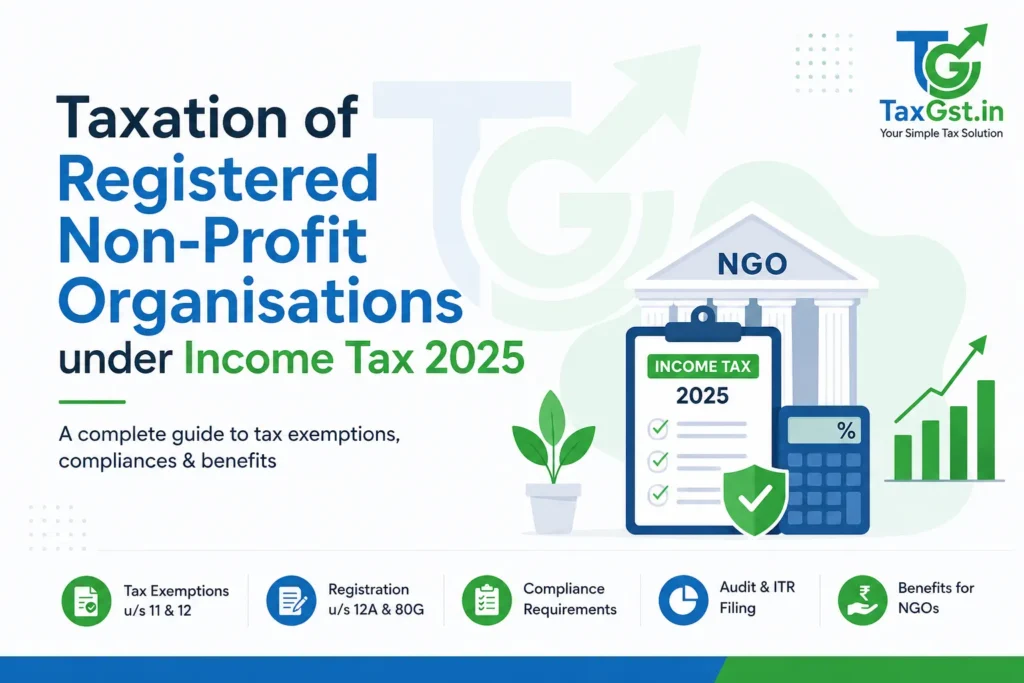
Registered Non-Profit Organisations (NPOs) in India are taxed under a dedicated framework in Part B of Chapter XVII of the Income-tax Act, 2025 (Sections 332 to 355). Regular income is exempt if at least 85% is applied for charitable or religious purposes, while specified income from violations like anonymous donations, prohibited investments, and misuse of funds is taxed at a flat 30% rate under Section 334.
Also Check-SEBI Revises Nomination Rules for Demat Accounts and Mutual Funds
Quick Summary
- Sections 334 to 338 of the Income-tax Act, 2025 govern the taxation of registered NPOs.
- Regular income is exempt if 85% or more is applied or accumulated for charitable or religious purposes under Section 336.
- Specified income — including anonymous donations above threshold, benefits to related persons, and non-compliant investments — is taxed at 30% under Section 334(1)(a).
- Residual income not falling under regular or specified categories is taxed at normal applicable rates.
- Registration under Section 332 is mandatory to claim any exemption benefit.
What Does the New NPO Taxation Framework Under Income-tax Act, 2025 Actually Mean?
The Income-tax Act, 2025 has consolidated and restructured the entire taxation regime for registered Non-Profit Organisations into Part B of Chapter XVII, covering Sections 332 to 355. Earlier, under the Income-tax Act, 1961, these provisions were scattered across multiple sections — Section 12A, 12AA, 12AB, Section 11, Section 12, and Section 10(23C) — making interpretation complex and litigation-prone.
The new Act aims to simplify the structure, improve clarity, and streamline compliance for NPOs. Under Section 334(1), the total income-tax payable by a registered NPO for any tax year is the aggregate of two components. First, tax at 30% on specified income for that tax year. Second, tax at the rate applicable under other provisions of the Act on taxable regular income and any residual income.
This dual-rate structure is the cornerstone of the new framework — it separates compliant income from non-compliant income and taxes them differently. Think of it this way. Imagine your NPO’s income as water flowing into two separate buckets. The first bucket holds “regular income” — donations, property income, investment returns, and incidental business gains. This bucket gets the exemption benefit, but only if you pour at least 85% of it into your charitable or religious objects. The second bucket holds “specified income” — money that comes with strings attached or is handled in ways the law does not permit. Every drop in this second bucket is taxed at a flat 30%, no exemptions, no deductions.
How Are the Three Categories of NPO Income Defined and Taxed?
The Act classifies an NPO’s total income into three distinct categories, each with its own tax treatment. Understanding this classification is essential because a mistake in categorisation can lead to a 30% tax demand on income that would otherwise have been fully exempt.
Regular Income under Section 335 includes five specific streams. These are income from charitable or religious activities carried out by the NPO for which it is registered; income from property, deposits, or investments held wholly for charitable or religious purposes; voluntary contributions received; gains from permissible commercial activities computed as business income under Chapter IV-D; and any other income incidental to the NPO’s objects. This income is eligible for exemption under Section 336, provided the 85% application or accumulation condition is met.
Specified Income under Section 337 is an exhaustive list of twelve categories of income that attract the 30% flat rate. These include anonymous donations exceeding the prescribed threshold (5% of total donations or Rs 1,00,000, whichever is higher), income applied for the benefit of related persons, income applied outside India without CBDT approval, investments or deposits made in contravention of Section 350, accumulated income applied for purposes other than those for which it was accumulated, accumulated income that ceases to remain accumulated, accumulated income credited or paid to another registered NPO, income applied to non-charitable purposes, and any income determined by the Assessing Officer in excess of the income disclosed in the books of account under Section 344.
Residual Income covers income that does not fall under either regular or specified income. This includes income from charitable or religious activities not aligned with the NPO’s registered objects and prior period income from activities carried out before the tax year. Residual income is taxed at the normal applicable rate. Importantly, the 15% deemed accumulation benefit under Section 343 and the deemed application provisions under Section 341(5) are available only against regular income, not against residual income.
How Does the 85% Application Rule Work in Practice Under Section 336?
The 85% rule under Section 336 is the single most important condition that determines whether your NPO’s regular income qualifies for tax exemption. The rule is straightforward in principle but requires careful computation in practice. Under Section 336, the taxable regular income of a registered NPO for any tax year is nil if at least 85% of the regular income of that tax year has been applied under Section 341 or accumulated under Section 342 for charitable or religious purposes. If the NPO fails to meet this threshold, the taxable regular income becomes 85% of the regular income for that tax year as reduced by the actual amount applied or accumulated.
In other words, the shortfall between 85% and the actual amount applied becomes taxable. Let me illustrate this with a practical example. Suppose a registered NPO has a regular income of Rs 50,00,000 for the tax year 2026-27. If the NPO applies or accumulates at least Rs 42,50,000 (which is 85% of Rs 50,00,000) towards its charitable objects, the entire taxable regular income becomes nil under Section 336(a). However, if the NPO applies only Rs 35,00,000, the shortfall is Rs 7,50,000 (Rs 42,50,000 minus Rs 35,00,000), and this Rs 7,50,000 becomes the taxable regular income under Section 336(b), which is then taxed at the applicable rate.
It is important to note that the 85% application must be for charitable or religious purposes in India for which the NPO is registered. Application of income outside India requires CBDT approval under Section 338(a) to qualify. Additionally, only 85% of any donation given to another registered NPO is treated as application — the remaining 15% does not qualify. Corpus donations and loan repayments are not treated as application, but reinvestment of corpus or repayment of loans within 5 years is allowed as deemed application under Section 341.
What Counts as Specified Income and Why Does It Attract a Flat 30% Rate?
Section 337 provides an exhaustive list of twelve categories of income that are treated as specified income and taxed at a flat 30% rate under Section 334(1)(a). The legislative intent is clear — these are incomes that either arise from non-compliant actions or represent funds that the NPO is not handling in accordance with the law’s requirements. By taxing these at a flat 30% rate without any deductions or exemptions, the Act creates a strong deterrent against misuse of the NPO framework.
The twelve categories of specified income under Section 337 include:
- Anonymous Donations Exceeding 5% of Total Donations or Rs 1,00,000 (whichever Is Higher);
- Income Applied Directly or Indirectly for The Benefit of Related Persons;
- Income Applied Outside India without Cbdt Approval;
- Investments or Deposits Made in Contravention of Section 350 out Of Income, Accumulated Income, Corpus, or Any Other Fund;
- Deemed Corpus Donations Where Conditions Under Section 340 Are Violated;
- Accumulated Income Applied for Purposes Other than Those for Which It Was Accumulated;
- Accumulated Income that Ceases to Remain Accumulated;
- Accumulated Income Not Applied Within the Permitted Accumulation Period;
- Accumulated Income Credited or Paid to Another Registered Npo;
- Income Applied to Purposes Other than Charitable or Religious Objects;
- Income Determined by The Assessing Officer in Excess of Books of Account Under Section 344;
- And Assets Not Held in The Forms Specified in Schedule Xvi.
The anonymous donation threshold deserves special attention. For a non-religious charitable trust, if anonymous cash donations exceed 5% of total receipts or Rs 1,00,000 (whichever is higher), the excess amount is treated as specified income and taxed at 30%. The balance amount within the threshold is taxed at normal rates. This provision targets the risk of money laundering through cash donations while allowing a reasonable threshold for small, genuine anonymous contributions.
Old Regime vs New Regime: Key Structural Changes for NPOs
The Income-tax Act, 2025 has brought significant structural changes to the NPO taxation framework compared to the earlier Income-tax Act, 1961. The table below captures the most important differences that every NPO practitioner and trustee should understand.
| Parameter | Income-tax Act, 1961 | Income-tax Act, 2025 |
|---|---|---|
| Governing provisions | Sections 11, 12, 12A, 12AA, 12AB, 10(23C) — scattered | Sections 332 to 355 — consolidated in Part B of Chapter XVII |
| Tax on specified/violation income | No separate category; taxed at maximum marginal rate | Flat 30% under Section 334(1)(a) on specified income under Section 337 |
| Regular income exemption condition | 85% application under Section 11(1) | 85% application under Section 336 read with Section 341/342 |
| Deemed accumulation (15%) | Section 11(2) — 15% of income | Section 343 — 15% of regular income after application |
| Fresh registration form | Form 10A | Form 104 under Rule 181 |
| Regular registration/renewal form | Form 10AB | Form 105 under Rule 181 |
| Accumulation statement form | Form 10 | Form 109 under Rule 185 |
| Audit report form | Form 10B / 10BB | Form 112 under Rule 188 |
| Smaller NPO extended validity | Not available | 10 years if income below Rs 5 crore in each of two preceding tax years under Section 332(5) |
| Deemed application option | Form 9A | Form 108 under Rule 184 |
The shift from scattered provisions to a consolidated chapter is not merely cosmetic. Under the old regime, a trust had to navigate Section 11 for exemption, Section 12 for voluntary contributions, Section 12AB for registration, and Section 10(23C) for approval — each with its own set of rules, forms, and judicial interpretations. The new Act consolidates all of this into a single, coherent framework, reducing the scope for interpretive disputes and making compliance more straightforward.
What Are the Key Compliance Requirements for Registered NPOs?
The compliance framework for registered NPOs under the Income-tax Act, 2025 is structured around five pillars: registration, income computation, application and accumulation, audit, and return filing. Each pillar has specific forms, timelines, and conditions that must be satisfied.
Registration under Section 332 is the gateway to all exemption benefits. Fresh NPOs that have not commenced activities must file Form 104 for provisional registration, which is valid for 3 tax years. The Principal Commissioner must pass an order in Form 106 within 1 month from the end of the month in which the application is made. For regular registration, Form 105 must be filed at least 6 months before the expiry of provisional registration or within 6 months of commencement of activities, whichever is earlier. The order in Form 107 must be passed within 6 months from the end of the quarter in which the application is made. Regular registration is valid for 5 tax years, extendable to 10 tax years for smaller NPOs with total income not exceeding Rs 5 crore in each of the two preceding tax years.
Books of account and audit are mandatory under Sections 347 and 348. Every registered NPO must maintain books of account and get them audited if its total income exceeds the basic threshold. The audit report must be filed in Form 112 under Rule 188. This is a non-negotiable requirement — failure to file the audit report can lead to cancellation of registration under Section 351.
Income Tax Return filing under Section 349 read with Section 263(1)(a)(iii) is mandatory for all registered NPOs. The due date for filing ITR-7 is typically October 31 of the assessment year. Belated filing attracts not only late fees but also triggers a “specified violation” under Section 351, which can lead to cancellation of registration and imposition of accreted tax under Section 352.
Accumulation of income under Section 342 allows an NPO to set aside income for a specific purpose for up to 5 years. The statement of accumulation must be filed in Form 109 before the due date for filing the return. The accumulated funds must be invested in permitted modes under Section 350. Any change in the purpose of accumulation requires an application in Form 110, and the Assessing Officer must approve the change in Form 111.
Donation compliance requires the NPO to file a statement of donations received in Form 113 under Rule 190 and issue donation certificates in Form 114. These forms are critical for donors who wish to claim deduction under Section 133(1)(b)(ii) of the Act.
What Is the Step-by-Step Registration Process for NPOs Under Section 332?
Registration under Section 332 of the Income-tax Act, 2025 is the gateway to claiming any tax exemption benefit. Without this registration, an NPO is treated as a regular taxpayer with no access to the 85% exemption mechanism. The registration process involves two stages — provisional and regular — each with its own form, timeline, and conditions.
Stage 1: Provisional Registration (Form 104) For a brand-new trust that has not yet commenced any charitable or religious activities and has no prior tax registration history, the first step is to file Form 104 on the e-filing portal at incometax.gov.in. This form replaces the old Form 10A under the Income-tax Act, 1961. The application can be submitted at any time during the tax year from which registration is sought. Upon receipt, the Principal Commissioner of Income Tax (PCIT) or Commissioner of Income Tax must issue an order in Form 106 within one month from the end of the month in which the application is made. The provisional registration is valid for three tax years or up to six months from the commencement of activities, whichever is earlier.
Stage 2: Regular Registration (Form 105) Before the provisional registration expires, the NPO must apply for regular registration by filing Form 105. This form replaces the old Form 10AB. The application must be filed at least six months prior to the expiry of the three-year provisional registration, or within six months of the actual commencement of activities, whichever is earlier. The PCIT or Commissioner must pass the final order in Form 107 within six months from the end of the quarter in which the application is made. The regular registration is valid for five tax years. However, under Section 332(5), if the NPO’s total gross receipts do not exceed Rs 5 crore in each of the two preceding tax years, the validity is extended to ten tax years — a significant relief for smaller organisations.
What Documents and Forms Are Required for NPO Compliance Under the 2025 Act?
The Income-tax Rules, 2026 have introduced a completely new set of forms replacing the old 1962 Rules. Every NPO must familiarise itself with these new forms to avoid rejection of applications or notices from the department. The key forms under the new regime are as follows:
| Compliance Purpose | Old Form (1962 Rules) | New Form (2026 Rules) | Governing Section |
|---|---|---|---|
| Fresh/Provisional Registration | Form 10A | Form 104 | Section 332(8) |
| Regular Registration/Renewal | Form 10AB | Form 105 | Section 332(3) |
| Order for Provisional Registration | Form 10AC | Form 106 | Section 332(8) |
| Order for Regular Registration | Form 10AD | Form 107 | Section 332(3) |
| Deemed Application Option | Form 9A | Form 108 | Section 341(7) |
| Accumulation for 5 Years | Form 10 | Form 109 | Section 342(1) |
| Change of Purpose of Accumulation | Not prescribed | Form 110 | Section 342(5) |
| Order Approving Change | Not prescribed | Form 111 | Section 342(5) |
| Audit Report | Form 10B/10BB | Form 112 | Section 348 |
| Statement of Donations | Form 10BD | Form 113 | Section 354 |
| Donation Certificate | Form 10BE | Form 114 | Section 354 |
Along with Form 105, the NPO must attach several supporting documents. These include self-certified copies of the trust deed or instrument of formation, self-certified copies of annual accounts for up to three preceding tax years (if the NPO has been in existence), self-certified copies of documents evidencing adoption or modification of objects (if applicable), and details of office bearers including their relationship with the NPO and shareholding percentage. Where a business undertaking is held by the NPO as property, the audit report under Section 345 for the relevant period must also be attached.
Who Is Eligible and What Conditions Must an NPO Satisfy to Claim Exemption?
Not every charitable or religious organisation automatically qualifies for tax exemption. The Act prescribes specific eligibility criteria and ongoing conditions that must be satisfied at all times. The NPO must be registered or incorporated in India for charitable or religious purposes under Section 332(2). It must not be established for the benefit of any particular religious community or caste other than the Scheduled Castes, Scheduled Tribes, backward classes, women, and children — this condition applies to NPOs created after the commencement of the Act.
The trust deed must be irrevocable. The NPO must not apply any part of its income for private religious purposes that do not enure for the benefit of the public. For NPOs carrying out advancement of any other object of general public utility, the aggregate receipts from commercial activities must not exceed 20% of the total receipts of the relevant tax year. Separate books of accounts must be maintained for any commercial activity. The NPO must comply with all other applicable laws and must not carry out any activity that is not genuine or not in accordance with the conditions of registration.
The registration can be cancelled by the PCIT or Commissioner only upon the occurrence of a “Specified Violation” under Section 351. These include failure to meet the 85% application rule, belated filing of ITR-7 under Section 263, acceptance of cash anonymous donations exceeding the threshold, acceptance of cash donations exceeding Rs 2,000 from a single donor, and investments made outside the permitted modes under Section 350. Upon cancellation, the NPO becomes liable for exit tax or accreted tax under Section 352, which is computed on the fair market value of the NPO’s assets.
How Is Total Income Computed for a Registered NPO Under the New Act?
The computation of total income for a registered NPO follows a structured methodology that separates regular income, residual income, and specified income. Getting this computation wrong is one of the most common reasons for tax notices, so precision matters.
Step 1: Compute Regular Income Start with the gross regular income, which includes income from charitable or religious activities under Section 335(a), income from property, deposits, or investments held for charitable purposes under Section 335(b), voluntary contributions under Section 335(d), and gains from permissible commercial activities under Section 335(e). From this gross amount, deduct revenue expenditure incurred in India for the objects of the NPO, including salaries, rent, and programme costs.
Add back disallowed expenditure such as amounts spent outside India, expenditure not for the NPO’s objects, expenditure out of opening corpus, expenditure from loans or borrowings, depreciation on assets whose acquisition was already treated as application, contributions or donations to other persons, cash expenditure exceeding Rs 10,000 disallowed under Section 353(3)(g), and TDS non-compliance disallowances under Section 353(3)(h).
Step 2: Deduct Application and Accumulation From the net regular income, deduct the amount applied for charitable or religious purposes in India under Section 341(1)(a), 85% of donations to other registered NPOs under Section 341(1)(b), capital expenditure, reinvestment of corpus under Section 341(2)(a), repayment of loans under Section 341(2)(b), deemed application under Section 341(5), and accumulation under Section 342. The balance is the regular taxable income, which is then tested under Section 336 for the 85% exemption threshold.
Step 3: Compute Specified Income Specified income under Section 337 is computed separately and includes all twelve categories described earlier. This income is taxed at a flat 30% under Section 334(1)(a) with no deductions or exemptions available.
Step 4: Compute Residual Income Residual income includes income from activities not aligned with the NPO’s registered objects and prior period income. This is taxed at normal applicable rates. Importantly, the 15% deemed accumulation under Section 343 is available only against regular income, not against residual income. The sum of tax on taxable regular income, tax on specified income at 30%, and tax on residual income gives the total income-tax payable by the registered NPO for the tax year.
What Are the Most Common Compliance Pitfalls That Trigger a 30% Tax Demand?
In practice, the most frequent reason NPOs face a 30% tax demand is misclassification of income or failure to meet the 85% application threshold. Here are the pitfalls that practitioners see repeatedly.
Pitfall 1: Anonymous Donations Above the Threshold. Under Section 337, anonymous donations exceeding 5% of total donations or Rs 1,00,000 (whichever is higher) are treated as specified income and taxed at 30%. Many trusts receive cash donations during fundraising events without recording donor details. If the aggregate of such anonymous donations crosses the threshold, the entire excess amount — not just the marginal excess — attracts the 30% rate. The solution is simple: maintain a donor register with name, address, PAN, and amount for every donation received. For small cash collections, issue numbered receipts and record the aggregate with a note that individual details are unavailable.
Pitfall 2: Application of Income for Related Persons. Section 337 treats any income applied, directly or indirectly, for the benefit of related persons as specified income. This includes paying excessive salaries to trustees’ relatives, renting property owned by a trustee at above-market rates, or awarding contracts to entities controlled by office bearers. The Assessing Officer examines the substance of the transaction, not just its form. Every payment to a related person must be at arm’s length and supported by a board resolution and market benchmarking.
Pitfall 3: Non-Compliant Investments Under Section 350. Accumulated income must be invested in permitted modes specified under Section 350. If the NPO invests in instruments outside the permitted list — such as equity shares of private companies, speculative instruments, or real estate for non-charitable purposes — the income arising from such investments is treated as specified income under Section 337 and taxed at 30%.
Pitfall 4: Failure to File Form 109 for Accumulation. Under Section 342, if the NPO wishes to accumulate income for a specific purpose for up to 5 years, it must file Form 109 before the due date for filing the return under Section 263(1). Failure to file this form on time means the entire accumulated amount loses its exemption and becomes taxable regular income.
How Do the Old and New Regimes Compare for NPO Compliance?
The shift from the Income-tax Act, 1961 to the Income-tax Act, 2025 has brought significant structural changes for NPOs. The following comparison highlights the key differences that practitioners and trusts must understand.
| Compliance Aspect | Income-tax Act, 1961 | Income-tax Act, 2025 |
|---|---|---|
| Governing Sections | Sections 11, 12, 12A, 12AA, 12AB, 10(23C) | Sections 332 to 355 (Part B of Chapter XVII) |
| Fresh Registration Form | Form 10A | Form 104 |
| Regular Registration/Renewal Form | Form 10AB | Form 105 |
| Provisional Registration Order | Form 10AC | Form 106 |
| Regular Registration Order | Form 10AC/10AD | Form 107 |
| Accumulation Statement | Form 10 | Form 109 |
| Audit Report | Form 10B/10BB | Form 112 |
| Deemed Application Option | Form 9A | Form 108 |
| Change of Purpose of Accumulation | No prescribed form | Form 110 |
| Statement of Donations | Form 10BD | Form 113 |
| Donation Certificate | Form 10BE | Form 114 |
| Standard Deduction on Gross Income | 15% of gross income under Section 11(1)(a) | 15% standard deduction on gross income (includes voluntary donations, property income, investment income, and incidental business income; excludes corpus donations) |
| Smaller NPO Registration Validity | 5 years uniformly | 10 years if total income does not exceed Rs 5 crore in each of the two preceding tax years under Section 332(5) |
| Terminology | Assessment Year / Previous Year | Tax Year |
What Is the Tax Impact in Rupees? A Worked Example for FY 2026-27
Let us walk through a detailed numerical example to understand the actual tax liability of a registered NPO under the new framework. Scenario: A registered charitable trust has the following income and expenditure for the tax year 2026-27.
- Voluntary donations received: Rs 80,00,000 (of which Rs 6,00,000 is anonymous cash donations)
- Income from property held for charitable purposes: Rs 10,00,000
- Income from permissible commercial activity: Rs 8,00,000
- Corpus donations received: Rs 15,00,000
- Total donations received: Rs 80,00,000 (for computing anonymous donation threshold)
- Actual application for charitable purposes in India: Rs 62,00,000
- Accumulation for specific purpose (Form 109 filed on time): Rs 5,00,000
- Revenue expenditure for charitable objects: Rs 12,00,000
Step 1: Compute Regular Income. Gross regular income = Rs 80,00,000 (donations) + Rs 10,00,000 (property income) + Rs 8,00,000 (commercial income) = Rs 98,00,000. Note: Corpus donations of Rs 15,00,000 are excluded from regular income under Section 338 as per the corpus donation rules. Less: Revenue expenditure for objects = Rs 12,00,000. Taxable regular income before application = Rs 98,00,000 – Rs 12,00,000 = Rs 86,00,000.
Step 2: Check 85% Application Rule. 85% of regular income = 85% of Rs 86,00,000 = Rs 73,10,000. Actual application + accumulation = Rs 62,00,000 + Rs 5,00,000 = Rs 67,00,000. Shortfall = Rs 73,10,000 – Rs 67,00,000 = Rs 6,10,000. Since the NPO has not met the 85% threshold, the taxable regular income under Section 336(b) is the shortfall of Rs 6,10,000. This is taxed at the normal applicable rate.
Step 3: Compute Specified Income. Anonymous donations threshold = Higher of 5% of total donations (5% of Rs 80,00,000 = Rs 4,00,000) or Rs 1,00,000 = Rs 4,00,000. Anonymous donations received = Rs 6,00,000. Excess anonymous donations = Rs 6,00,000 – Rs 4,00,000 = Rs 2,00,000. This Rs 2,00,000 is specified income under Section 337 and is taxed at 30% under Section 334(1)(a).
Step 4: Compute Total Tax. Tax on taxable regular income of Rs 6,10,000 at applicable rates (assuming the NPO falls in the 30% bracket) = Rs 1,83,000 (plus applicable cess). Tax on specified income of Rs 2,00,000 at 30% = Rs 60,000 (plus applicable cess). Total tax payable = Rs 1,83,000 + Rs 60,000 = Rs 2,43,000 (before cess). If the NPO had applied Rs 73,10,000 or more (met the 85% threshold), the taxable regular income would have been nil, and the only tax would have been on the Rs 2,00,000 specified income — just Rs 60,000 before cess. The difference in tax liability between compliance and non-compliance is Rs 1,83,000 in this example.
This is why the 85% rule is the single most impactful compliance requirement for any registered NPO.
What Are the Key Conditions for Maintaining Registration and Avoiding Cancellation?
Under the Income-tax Act, 2025, registration under Section 332 is not a one-time event. It comes with ongoing compliance conditions, and failure to meet them can lead to cancellation under Section 351 and the imposition of accreted tax under Section 352. The registration cannot be cancelled for ordinary, minor compliance issues. Cancellation is triggered only upon the occurrence of a “Specified Violation” as defined under Section 351.
These specified violations include: failure to meet the 85% application rule; belated filing of the income tax return under Section 263; acceptance of anonymous cash donations exceeding the threshold for non-religious charitable trusts; acceptance of regular donations exceeding Rs 2,000 in physical cash from a single donor; investment of funds in modes not permitted under Section 350; and providing false or incorrect information in the registration application. When a specified violation is established, the Principal Commissioner or Commissioner is statutorily empowered to cancel the registration. Upon cancellation, the NPO becomes liable to pay accreted tax under Section 352.
What Should You Do Next?
- Review your NPO’s income classification for the current tax year — identify which streams qualify as regular income, specified income, and residual income under Sections 335, 337, and 355(j).
- Verify that at least 85% of your regular income has been applied or accumulated for charitable or religious purposes as required under Section 336 — prepare a detailed application statement before filing your return.
- File Form 109 for accumulation of income (if applicable) before the due date for filing the return under Section 263(1) — late filing of Form 109 can result in denial of the accumulation benefit.
- Ensure all investments and deposits are made strictly in the permitted modes under Section 350 — any non-compliant investment becomes specified income taxable at 30%.
- Check your anonymous donation register — if anonymous donations exceed 5% of total donations or Rs 1,00,000 (whichever is higher), the excess amount must be offered to tax at 30% under Section 337.
- Review all related-party transactions — any income applied for the benefit of a trustee, settler, or their relatives is treated as specified income and taxed at 30%.
- If your NPO is approaching the end of its registration validity, file Form 105 for renewal at least 6 months before expiry — smaller NPOs with gross receipts below Rs 5 crore in each of the two preceding tax years may be eligible for 10-year validity under Section 332(5).
Frequently Asked Questions
Can an NPO avoid the 30% tax on anonymous donations by splitting them across multiple donors?
No. The law under Section 337 looks at the substance of the transaction, not just the form. Anonymous donations are defined as contributions where the identity of the donor is not recorded or where the donor’s identity cannot be ascertained. If your NPO receives multiple small donations without recording donor details specifically to stay below the 5% threshold or Rs 1,00,000 limit, the Assessing Officer can aggregate all such anonymous donations and apply the 30% tax on the excess amount. The threshold is 5% of total donations received or Rs 1,00,000, whichever is higher. Only the amount up to this threshold is treated as regular income — everything above it becomes specified income. The best practice is to maintain proper donor records for every contribution received, regardless of the amount.
Is income from a business undertaking held by an NPO always treated as specified income?
No. Income from a business undertaking held by an NPO as property is actually included in regular income under Section 335(e), provided separate books of accounts are maintained for the business activity and the income is computed as business income under Chapter IV-D. This regular income then qualifies for the 85% exemption under Section 336. However, there is an important exception under Section 337(12) — if the Assessing Officer determines under Section 344 that the income of the business undertaking exceeds the income disclosed in the books of account, that excess amount is treated as specified income and taxed at 30%. So the key is maintaining accurate books of account and ensuring the declared business income matches the actual operations.
Can an NPO apply income outside India without losing its exemption?
Yes, but only with prior approval from the CBDT under Section 338(a). Income applied outside India will not be included in the regular income of a registered NPO if the CBDT has, by a general or special order, directed such exclusion. The approval is typically granted in two situations: first, where the NPO was created before April 1, 1952 for charitable or religious purposes; and second, where the NPO was created on or after April 1, 1952 for charitable purposes, and the application of income outside India is intended to promote international welfare in which India has an interest. Without this approval, any income applied outside India is treated as specified income under Section 337 and taxed at 30%. The application for approval should be made before the income is actually applied outside India.
What happens if an NPO fails to utilise accumulated income within the 5-year period under Section 342?
If accumulated income under Section 342 is not applied for the charitable or religious purposes for which it was accumulated within the specified 5-year period, it is treated as specified income under Section 337 and becomes taxable at 30% in the tax year in which the 5-year period expires. There is an additional consequence — if the accumulated income ceases to remain accumulated or set apart for the specified purpose at any time before the 5-year period ends, it is also treated as specified income and taxed in the year of such cessation.
The NPO can apply to the Assessing Officer in Form 110 for a change in the purpose of accumulation, which, if approved, can prevent the tax levy. The key takeaway is that accumulation is not a permanent parking mechanism — the funds must be actively utilised for the stated purpose within the permitted timeframe.
What Are the Most Common Compliance Mistakes That Trigger Notices for NPOs?
Based on practical experience, certain errors appear repeatedly in NPO assessments. First, many organisations fail to distinguish between corpus donations and regular voluntary contributions. Corpus donations are capital receipts excluded from regular income under Section 338, but only if they are specifically earmarked as corpus and invested in permitted modes under Section 350. If you mix corpus funds with regular income and spend them on routine expenses, the entire corpus amount can lose its exempt status and be pulled into the specified income net. Second, the anonymous donation threshold under Section 337 is frequently miscalculated. The limit is 5% of total donations received or Rs 1,00,000, whichever is higher.
Many NPOs apply only the Rs 1,00,000 cap without considering the 5% of total donations rule. If your total donations are Rs 30,00,000, the permissible anonymous donation is Rs 1,50,000 (5%), not Rs 1,00,000. The excess Rs 50,000 becomes specified income taxable at 30%. Third, NPOs often forget that donations to other registered NPOs qualify as application only to the extent of 85% of such donations. The remaining 15% is not treated as application. If your NPO donates Rs 10,00,000 to another registered NPO, only Rs 8,50,000 counts toward your 85% application requirement. The balance Rs 1,50,000 does not qualify, and this shortfall can create a taxable position under Section 336(b). Fourth, filing ITR-7 after the due date under Section 263 is a specified violation under Section 351 that can lead to cancellation of registration. Even if all other conditions are met, a belated return can trigger cancellation and attract accreted income tax under Section 352.
Sources
- TaxGuru — Taxation of Registered Non-Profit Organisations under Income Tax 2025
- TaxGuru — Computation of Total Income of Registered NPOs under Income Tax Act 2025
- Income Tax India — FAQs on Forms as per Income-tax Rules, 2026
- TaxGuru — Income Tax Act 2025: A New Compliance Regime For NPOs
- Income Tax India — Form No. 105
- TaxGuru — Income Tax and GST Compliance applicable to Registered Non-Profit Organisation
- Income Tax India — Form No. 105 (PDF)
- Income Tax India — Form No. 106
Need help with NPO tax compliance for FY 2026-27? Our team of chartered accountants and tax practitioners specialises in NPO taxation under the Income-tax Act, 2025. From registration in Form 105 to ITR-7 filing and specified income computation, we ensure your organisation stays fully compliant while maximising your tax-exempt benefits. Book a consultation today and let us handle the complexity while you focus on your charitable mission.
Article Information
Published: June 8, 2026
Last Reviewed: June 8, 2026
Category: Income Tax
Regulatory Body: CBDT (Central Board of Direct Taxes)
Written by C.K. Gupta, M.Com & Tax Editor at TaxGST.in — helping 500+ clients navigate IT notices, GST audits, and ITR filings across Delhi NCR since 2009.
Official Resources
Disclaimer: This article is for informational purposes only. For legal advice, consult a qualified tax professional. Always refer to the original source document for authoritative information.
Discover more from TaxGst.in
Subscribe to get the latest posts sent to your email.



Stay Updated!
Join our community for latest tax updates, GST news & finance tips